The Hidden Story Behind Your Resting Heart Rate: What Your RHR Can Reveal About Stress, Recovery & Adaptation
Author: Andrea Samadi
August 23, 2026
Duration: 30:40
Andrea Samadi shares her personal resting heart rate data to show why measuring over time matters more than fixating on a single score. She explains how trends reveal stress, recovery, and adaptation, and why comparing yourself to your own baseline is the most useful approach.
Learn practical steps to measure consistently, contextualize changes, experiment with one behavior, and use your physiological data to make intentional improvements in sleep, recovery, and performance.
BONUS EPISODE 3: ON THIS EPISODE, WE’LL COVER
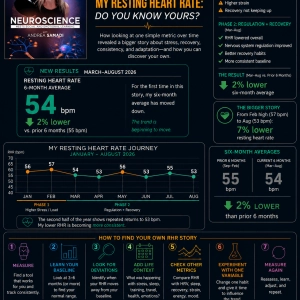
✔ What resting heart rate can reveal about stress, recovery, and adaptation over time✔ The story hidden in my own data — from a high of 57 bpm in February to 53 bpm in August✔ Why the six-month trend matters — and what my 2% lower average may be telling me✔ How stress and training load can show up in your physiology before you consciously recognize it✔ Why recovery and nervous-system regulation matter for building a more resilient baseline✔ How to find your own RHR baseline instead of comparing yourself with someone else✔ How to look for deviations and patterns across weeks and months—not individual days✔ How to connect RHR with sleep, HRV, recovery, training, stress, and life events✔ How to run your own personal experiment: change one variable, measure, and see what happens✔ The bigger lesson: What gets measured over time can reveal a story you couldn't see day to day.
Welcome back to the Neuroscience Meets Social and Emotional Learning Podcast, where we bridge neuroscience, social and emotional learning, and human performance so we can create measurable improvements in our well-being, achievement, leadership, productivity, and results.
I’m Andrea Samadi, and if you’ve been following along through Season 16, you’ll know that we’ve been building what I call The Brain’s Operating System for Human Performance—a neuroscience-based framework designed to help us understand how the different systems of the brain and body work together to influence how we learn, adapt, connect, lead, and ultimately how we perform.
We are currently in Phase 3 where we are covering Movement, Learning and Cognition.
If you just finished Episode 405[i] with Dr. Kristen Holmes, you know we've been looking at recovery as an essential part of our Movement Loop.
Movement → Brain Activation → Attention → Learning → Recovery → Adaptation → Performance → Greater Capacity.
And Kristen's work has reinforced something I've learned after years of tracking my own physiology:
What gets measured gets improved.
But this week, I wanted to dive into my own personal data to show us something I think is easy to miss:
Sometimes what gets measured over time reveals a story you simply couldn't see day to day.
When we're looking at a wearable every morning, it's easy to become focused on today's number.
Today's recovery score.
Today's HRV.
Today's resting heart rate.
Was it higher? Was it lower?
But one number—or even one week—rarely tells us very much about the direction we're actually moving.
It's when we begin to zoom out that patterns emerge.
And that's exactly what happened when I looked more closely at my resting heart rate this year.
What initially looked like a collection of numbers began to tell a much bigger story about stress, recovery, consistency, and adaptation.
So my hope for this episode isn't that you compare your resting heart rate to mine.
Your numbers will be different.
My hope is that this episode encourages you to become curious about your own data.
Maybe you track sleep.
Maybe it's HRV.
Resting heart rate.
Recovery.
Exercise.
Blood pressure.
Steps.
Or even something as simple as your energy, mood, or ability to focus.
Take one metric and zoom out.
Look at three months.
Six months.
Maybe even a year.
And instead of asking, “Is today's number good or bad?”
Ask a different question:
“What is the trend that I’m seeing here, trying to tell me?”
Is something improving?
Is something slowly moving in the wrong direction?
Does your ph