In this episode of NTSB News Talk, hosts Max Trescott and Rob Mark explore a series of recent general aviation accidents that underscore persistent issues around loss of control, distraction, weather misjudgment, and pilot training. The discussion is framed around several preliminary NTSB reports, each presenting scenarios where pilots encountered challenging situations and, in many cases, failed to maintain control of their aircraft.
They begin with the crash of a Rockwell Commander 114A in Hankamer, Texas. The pilot had taken his grandson on a pleasure flight from Baytown. ADS-B data showed casual maneuvering followed by a rapid, unexplained descent from 4,200 feet, with rates as high as 14,000 feet per minute and speeds over 200 knots. While weather data is incomplete, Max and Rob suspect the pilot may have been attempting to descend through a break in the clouds—leading to a spatial disorientation or loss of control scenario.
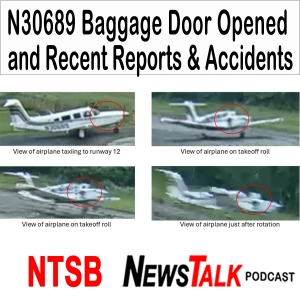
The conversation then moves to a fatal Piper Lance crash in Florida, caused by an unsecured nose baggage door. Surveillance video shows the door flapping open just after takeoff, and investigators found spilled contents—aviation oil and dog food—on the runway. Just 10 seconds later, the aircraft impacted the ground. Rob and Max explain that while such a distraction can be startling, it shouldn’t lead to a crash. Pilots need to remain calm and continue flying, especially during the critical initial climb phase.
A Saratoga crash, also in Florida, occurred during a night takeoff from Venice. Four people were killed. Max identifies the likely culprit: somatogravic illusion, in which acceleration during takeoff is misinterpreted by the brain as a climb. If no visual references are available—such as over water or on a moonless night—pilots may mistakenly push the nose down, leading to fatal descent. Rob emphasizes that night VFR can be as risky as IFR and urges pilots to brief night flights as if they're instrument flights. Max adds that despite being legal, flying in dark night conditions without an instrument rating is “crazy.”
Next is a Cessna 180 crash in Illinois. The aircraft departed during the day but returned amid mist and rain. The pilot, who lacked an instrument rating, hit wires and crashed, killing four. This highlights the risk of flying VFR into IMC and the human tendency to assume return conditions will mirror those from the outbound flight—a dangerous assumption in a dynamic weather environment.
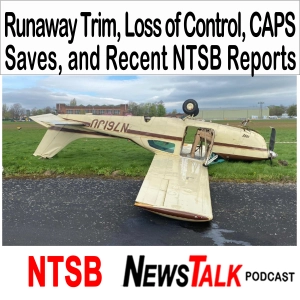
The final accident involves a Cessna 177RG Cardinal in California. The pilot, who was in the traffic pattern for Grass Valley Airport, reported engine failure just before turning base. The aircraft crashed inverted near a road, just short of the runway. Rob stresses this was a basic emergency pilots are trained for—power-off landings—and wonders if other factors, such as distraction from a passenger, played a role. Max notes that today's busy traffic patterns make it difficult to practice power-off landings, though they remain a valuable skill.
The conversation broadens into general safety themes. Max recalls how his early flight training focused on always landing power-off, and he encourages pilots to train under varied conditions to remain sharp. Rob warns that many pilots shy away from training maneuvers for fear of damaging their engines, but believes this hesitancy erodes skills.
They also touch on situational awareness—what Max calls “the what-if game.” As pilots climb out, they should continuously consider where they'd land in an emergency, adjusting that plan as altitude increases. Rob echoes the value of mental preparedness, even at higher altitudes, where situational awareness should be constant. He critiques pilots who rely on Bluetooth music midflight, arguing that distractions—even subtle ones—undermine readiness.
A side discussion on bird strikes leads to a reminder that pilots must continue flying the airplane after unexpected events. Max recounts several bird strikes he’s experienced, including one involving a helicopter tail rotor. Rob notes that even startling events—like birds hitting the aircraft—must not overwhelm a pilot’s primary task: maintain control.
They conclude with a suggestion to focus a future episode on loss of control in flight, the underlying theme in many of the accidents discussed. Rob points out that too many pilots lose control when confronted with the unexpected, often because their training didn’t adequately prepare them to manage surprise or panic.
Max and Rob leave listeners with a clear takeaway: no matter what happens—whether it's a noise, an open door, a failed engine, or a dark sky—your first job is always the same: fly the airplane.