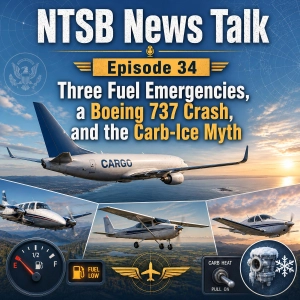
Three Fuel Emergencies, a Boeing 737 Crash, and the Carb-Ice Myth

Three Fuel Emergencies, a Boeing 737 Crash, and the Carb-Ice Myth

Author: Max Trescott | Aviation News Talk Network July 14, 2026 Duration: 36:18

Max Trescott and Rob Mark review a mysterious Boeing 737 cargo crash, several fuel-related accidents, loss of control, and a dangerous carb-ice misconception. K2 Airways Flight KTA1732, Boeing 737-400F AP-BOI, reported a navigation problem before plunging into the Arabian Sea. The hosts analyze Beechcraft 95-A55 Baron N7501S after an apparent dual-engine failure near Lancaster, South Carolina, following an 18-hour flying day, raising questions about fuel endurance, fatigue, and nighttime hypoxia.

Preliminary reports include Cessna 150L N156KA, where the instructor tried to select a nonexistent right-tank position and investigators found a striking fuel imbalance; Cessna P210N N54CC, which stalled and spun above a 9,550-foot runway; Pacific Aerospace 750XL N221BN, whose engine was producing power before a fatal skydiving crash; and experimental Piper PA-20 N7635K, which struck mountainous terrain while flying toward instrument conditions with a suspended certificate and expired medical.

Final reports cover Cessna 172M N4464R, whose seat slid aft during takeoff, and Cessna 182 N8580T, which lost power on final after the left tank ran dry despite fuel remaining in the right tank. Listener Sam Dawson closes with a warning that no carbureted airplane should be assumed immune from carb ice or what its POH may imply alone.


Ever wonder what really happens after the dust settles on an aviation accident? NTSB News Talk-Aviation Accidents, Safety Investigations & Pilot Lessons pulls back the curtain on the meticulous world of safety investigations, transforming complex reports into actionable knowledge. Hosted by award-winning aviation journalist Rob Mark alongside Max Trescott-a flight instructor with formal accident investigator training-each episode delves into recent findings from the National Transportation Safety Board. Their conversations move beyond the headlines to analyze the chain of events, human factors, and mechanical failures that lead to incidents. This isn't about sensationalism; it's a clear-eyed look at the facts, designed to translate tragedy into tangible lessons for those in the cockpit. Whether you're a seasoned pilot, a flight instructor shaping the next generation, or an enthusiast fascinated by the intricacies of flight safety, this podcast serves as a vital resource. You'll hear detailed breakdowns of specific cases, discussions on broader safety trends, and practical takeaways that can directly inform decision-making and checklists. The dialogue between a journalist's perspective and an instructor's hands-on experience creates a unique and authoritative tone, making technical details accessible and immediately relevant. Tune in for a sobering yet essential exploration of how the aviation community learns, adapts, and strives to make every flight safer.

Author: Language: English Episodes: 39

NTSB News Talk – Aviation Accidents, Safety Investigations & Pilot Lessons
Podcast Episodes
Fatal Pilot Errors: How Common Medications Led to Deadly Crashes [not-audio_url] [/not-audio_url]

Duration: 39:31
Max Trescott and Rob Mark explore one of the most overlooked killers in aviation: common medications that quietly impair pilots and contribute to fatal crashes. While many aviators think over-the-counter or prescription…
NTSB Board Member Michael Graham on Safety Culture, SMS, and GA Risks [not-audio_url] [/not-audio_url]

Duration: 52:42
In this episode of NTSB News Talk, hosts Max Trescott and Rob Mark welcome Michael Graham, a current member of the National Transportation Safety Board (NTSB), for a deep discussion on the agency’s work and the broader s…
NTSB Accident Reports: TBM & King Air Loss of Control [not-audio_url] [/not-audio_url]

Duration: 37:50
In Episode 10 of NTSB News Talk, aviation safety experts Max Trescott and Rob Mark examine recent accident reports that reinforce why loss of control in flight continues to be the number one cause of fatalities in genera…