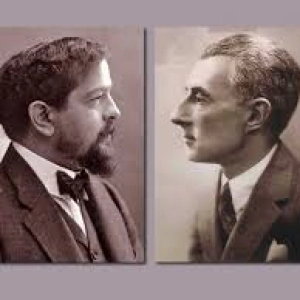
Best of Frenemies: Debussy and Ravel

Best of Frenemies: Debussy and Ravel

Author: Joshua Weilerstein April 3, 2025 Duration: 52:22

Debussy and Ravel are often described as the prototypical musical impressionists. It is often said that the two composers are the closest equivalents to the artistic world of Monet, Renoir, Pisarro, Degas, and others. But both Ravel and Debussy (like Monet for that matter), vehemently rejected the term Impressionism, and they both felt that they were striking out on their own individual paths in their msuic. That didn't stop the public and critics from constantly comparing the music of these two shining lights of French music, despite the fact that Ravel and Debussy are actually quite different. Comparing Ravel and Debussy is a bit like comparing Haydn and Mozart. At first glance, there are many similarities, but if you look and listen more closely, Ravel and Debussy(like Mozart and Haydn) had totally different approaches, goals, and styles.

All of the constant comparisons and attempts at making the composers compete with each other had a real impact on Debussy and Ravel. Initially they were friends and mutual admirers of each others work, but they slowly drifted apart over time until they stopped speaking to each other altogether. We'll talk about this complicated personal relationship, as well as looking at these differences in their music, not from a critical standpoint, but from the perspective of bringing out what is so wonderfully unique about their music. We'll also talk about Ravel's arrangements of two Debussy's greatest orchestral works: his two piano arrangement of Debussy's Nocturnes, and his piano 4 hands arrangement of the legendary Prelude to the Afternoon of a Faun. Join us on another collaboration with G Henle Publishers!

Recordings:

Nocturnes

Claudio Abbado with London Symphony
Anne Shasby, Richard McMahon, Piano

Prelude to the Afternoon of a Faun

Ravel arrangement: Jean-Pierre Armengaud and Olivier Chauzu
Debussy Arrangement: Charles Badami and Anthony Olson 


There’s a particular kind of curiosity that draws people to classical music, but the sheer scale of the repertoire can feel overwhelming. Sticky Notes: The Classical Music Podcast, hosted by conductor Joshua Weilerstein, meets that curiosity right where it is. Think of it as a series of open conversations about the music itself, designed to be equally engaging for someone hearing a symphony for the first time and for a lifelong devotee. Episodes might feature a thoughtful interview with a performing artist, offering a glimpse behind the curtain, or they could focus entirely on a single piece, peeling back its layers to explore why it resonates. Weilerstein guides these explorations with clarity and enthusiasm, moving seamlessly from foundational concepts to more nuanced details about different musical eras. The entire premise of this podcast is built on a genuine belief that this music belongs to all of us. It’s about replacing any sense of intimidation with connection and understanding. While past seasons are gradually being re-released, each episode stands as its own invitation to listen more deeply.
Author: Language: English Episodes: 50

Sticky Notes: The Classical Music Podcast
Podcast Episodes
Ravel, Ravel, Ravel, w/Boris Giltburg and G. Henle Verlag! [not-audio_url] [/not-audio_url]

Duration: 59:12
Magician, Swiss Watchmaker, Aloof, Elegant, Precise, Soulful, Childlike, Naive, Warm: these are all words that have been used to describe Maurice Ravel, a man of elegant contradictions. But perhaps these contradictions a…
Amy Beach, "Gaelic" Symphony [not-audio_url] [/not-audio_url]

Duration: 1:00:56
Amy Beach is a name that might not be familiar to you. She was born in 1867 and died in 1944, and her life was one of the most fascinating and varied in musical history. She was a child prodigy, became a successful piani…
Smetana: Ma Vlast [not-audio_url] [/not-audio_url]

Duration: 1:05:54
Nationalism, patriotism, cultural identity, a sense of home; these are concepts and ideas whose popularity have ebbed and flowed throughout history. Nationalism has been seen as a natural expression of cultural identity…
Berg Violin Concerto [not-audio_url] [/not-audio_url]

Duration: 48:49
In the early 1930s, at the height of the atonal and twelve tone movement in music, the American violinist Louis Krasner commissioned a concerto from the Viennese Composer Alban Berg. Berg declined at first, saying that h…
Beethoven String Quartet, Op. 135 [not-audio_url] [/not-audio_url]

Duration: 57:42
There is nothing like hearing a Late Beethoven String Quartet for the first time. Beethoven's late string quartets, Op. 127, Op. 130, Op. 131, Op. 132, and Op. 135, are among the 5 greatest pieces of music ever written f…
Berlioz Symphonie Fantastique LIVE w/ The Aalborg Symphony [not-audio_url] [/not-audio_url]

Duration: 1:12:20
I'm so happy to share this live episode of Sticky Notes that I did with the Aalborg Symphony Orchestra in Denmark back in October! This episode covered Berlioz's remarkable Symphonie Fantastique - the ultimate symphonic…
Shostakovich Symphony No. 8 [not-audio_url] [/not-audio_url]

Duration: 1:08:33
Here are two statements by Dmitri Shostakovich about the same piece, the 8th symphony that we are talking about today: Statement No. 1, Shostakovich's published comments about the symphony when it was first performed in…
Literary Works in Classical Music [not-audio_url] [/not-audio_url]

Duration: 46:31
My Patreon sponsor for this episode, Adrian, set me a challenge: The influence of literary works on classical compositions, exploring pieces inspired by poetry, novels, or plays. He also asked me to do something else, an…