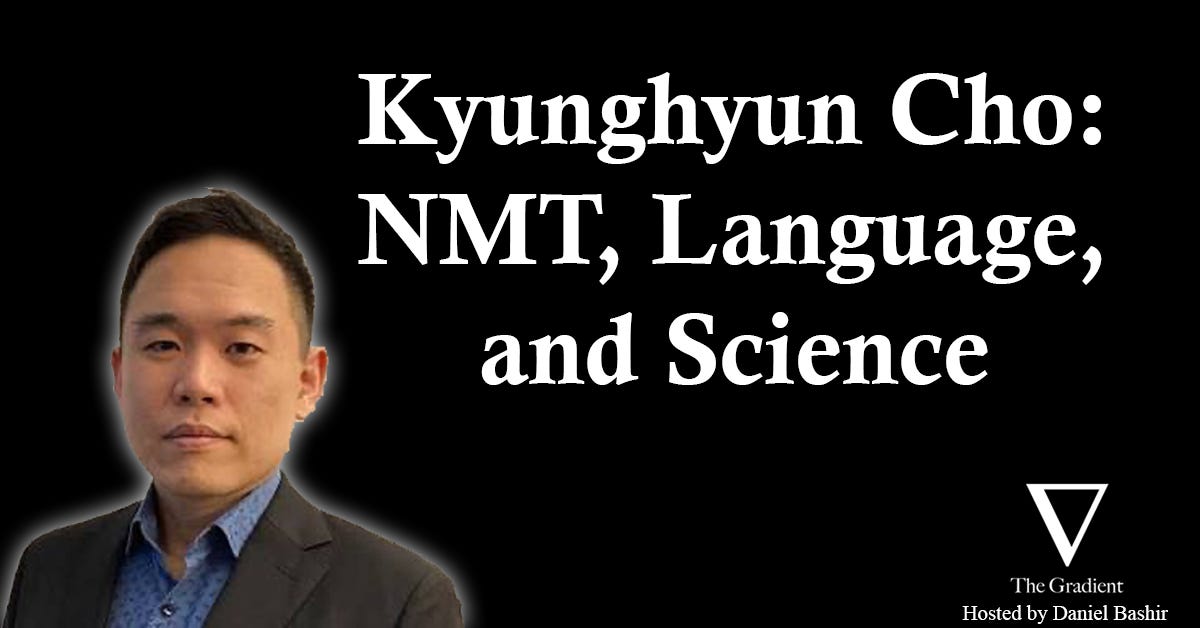
Kyunghyun Cho: Neural Machine Translation, Language, and Doing Good Science

Kyunghyun Cho: Neural Machine Translation, Language, and Doing Good Science

Author: Daniel Bashir February 9, 2023 Duration: 2:08:02

In episode 59 of The Gradient Podcast, Daniel Bashir speaks to Professor Kyunghyun Cho.

Professor Cho is an associate professor of computer science and data science at New York University and CIFAR Fellow of Learning in Machines & Brains. He is also a senior director of frontier research at the Prescient Design team within Genentech Research & Early Development. He was a research scientist at Facebook AI Research from 2017-2020 and a postdoctoral fellow at University of Montreal under the supervision of Prof. Yoshua Bengio after receiving his MSc and PhD degrees from Aalto University. He received the Samsung Ho-Am Prize in Engineering in 2021.

Have suggestions for future podcast guests (or other feedback)? Let us know here!

Subscribe to The Gradient Podcast:  Apple Podcasts  | Spotify | Pocket Casts | RSSFollow The Gradient on Twitter

Outline:

* (00:00) Intro

* (02:15) How Professor Cho got into AI, going to Finland for a PhD

* (06:30) Accidental and non-accidental parts of Prof Cho’s journey, the role of timing in career trajectories

* (09:30) Prof Cho’s M.Sc. thesis on Restricted Boltzmann Machines

* (17:00) The state of autodiff at the time

* (20:00) Finding non-mainstream problems and examining limitations of mainstream approaches, anti-dogmatism, Yoshua Bengio appreciation

* (24:30) Detaching identity from work, scientific training

* (26:30) The rest of Prof Cho’s PhD, the first ICLR conference, working in Yoshua Bengio’s lab

* (34:00) Prof Cho’s isolation during his PhD and its impact on his work—transcending insecurity and working on unsexy problems

* (41:30) The importance of identifying important problems and developing an independent research program, ceiling on the number of important research problems

* (46:00) Working on Neural Machine Translation, Jointly Learning to Align and Translate

* (1:01:45) What RNNs and earlier NN architectures can still teach us, why transformers were successful

* (1:08:00) Science progresses gradually

* (1:09:00) Learning distributed representations of sentences, extending the distributional hypothesis

* (1:21:00) Difficulty and limitations in evaluation—directions of dynamic benchmarks, trainable evaluation metrics

* (1:29:30) Mixout and AdapterFusion: fine-tuning and intervening on pre-trained models, pre-training as initialization, destructive interference

* (1:39:00) Analyzing neural networks as reading tea leaves

* (1:44:45) Importance of healthy skepticism for scientists

* (1:45:30) Language-guided policies and grounding, vision-language navigation

* (1:55:30) Prof Cho’s reflections on 2022

* (2:00:00) Obligatory ChatGPT content

* (2:04:50) Finding balance

* (2:07:15) Outro

Links:

* Professor Cho’s homepage and Twitter

* Papers

* M.Sc. thesis and PhD thesis

* NMT and attention

* Properties of NMT,

* Learning Phrase Representations

* Neural machine translation by jointly learning to align and translate

* More recent work

* Learning Distributed Representations of Sentences from Unlabelled Data

* Mixout: Effective Regularization to Finetune Large-scale Pretrained Language Models

* Generative Language-Grounded Policy in Vision-and-Language Navigation with Bayes’ Rule

* AdapterFusion: Non-Destructive Task Composition for Transfer Learning


Get full access to The Gradient at thegradientpub.substack.com/subscribe
Hosted by Daniel Bashir, The Gradient: Perspectives on AI moves beyond surface-level headlines to explore the intricate machinery and human ideas shaping artificial intelligence. Each episode is built on a foundation of deep research, leading to conversations that are both technically substantive and broadly accessible. You'll hear from researchers, engineers, and philosophers who are actively building and critiquing our technological future, discussing not just how AI systems work, but the larger implications of their integration into society. This isn't about speculative hype; it's a grounded examination of real progress, persistent challenges, and ethical considerations from those on the front lines. The discussions peel back layers on topics like model architecture, policy, and the fundamental science behind the algorithms becoming part of our daily lives. For anyone curious about the substance behind the buzz-whether you have a technical background or are simply keen to understand a defining technology of our age-this podcast offers a crucial and thoughtful resource. Tune in for a consistently detailed and nuanced take that treats artificial intelligence with the complexity it deserves.
Author: Language: English Episodes: 100

The Gradient: Perspectives on AI
Podcast Episodes
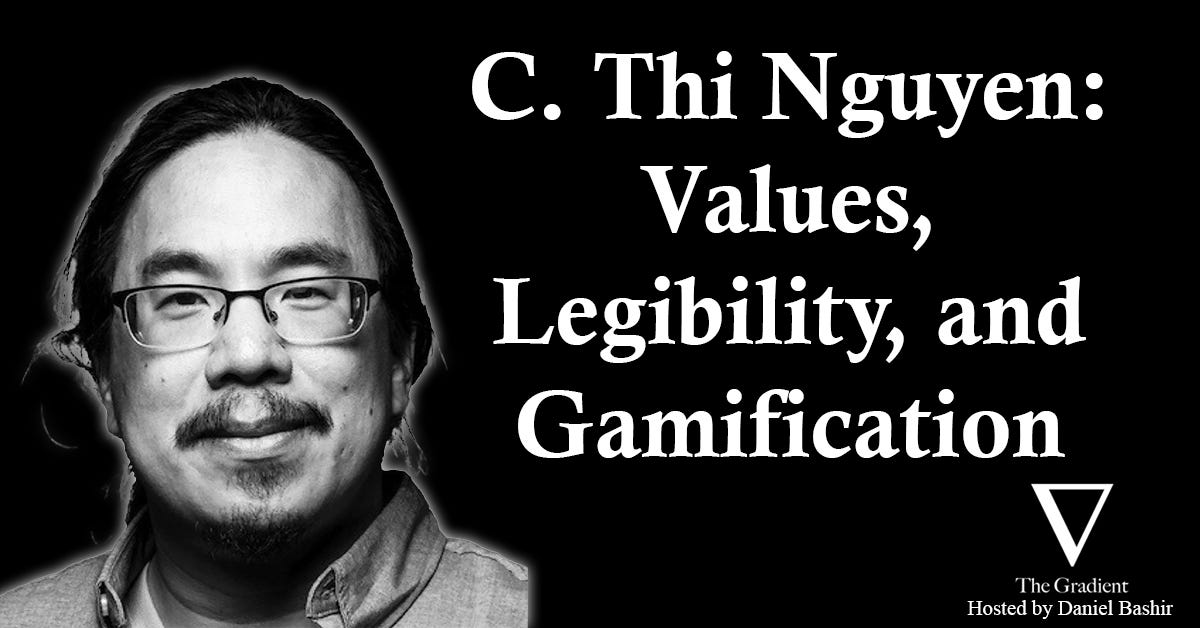
C. Thi Nguyen: Values, Legibility, and Gamification [not-audio_url] [/not-audio_url]

Duration: 1:30:13
Episode 127I spoke with Christopher Thi Nguyen about:* How we lose control of our values* The tradeoffs of legibility, aggregation, and simplification* Gamification and its risksEnjoy—and let me know what you think!C. Th…
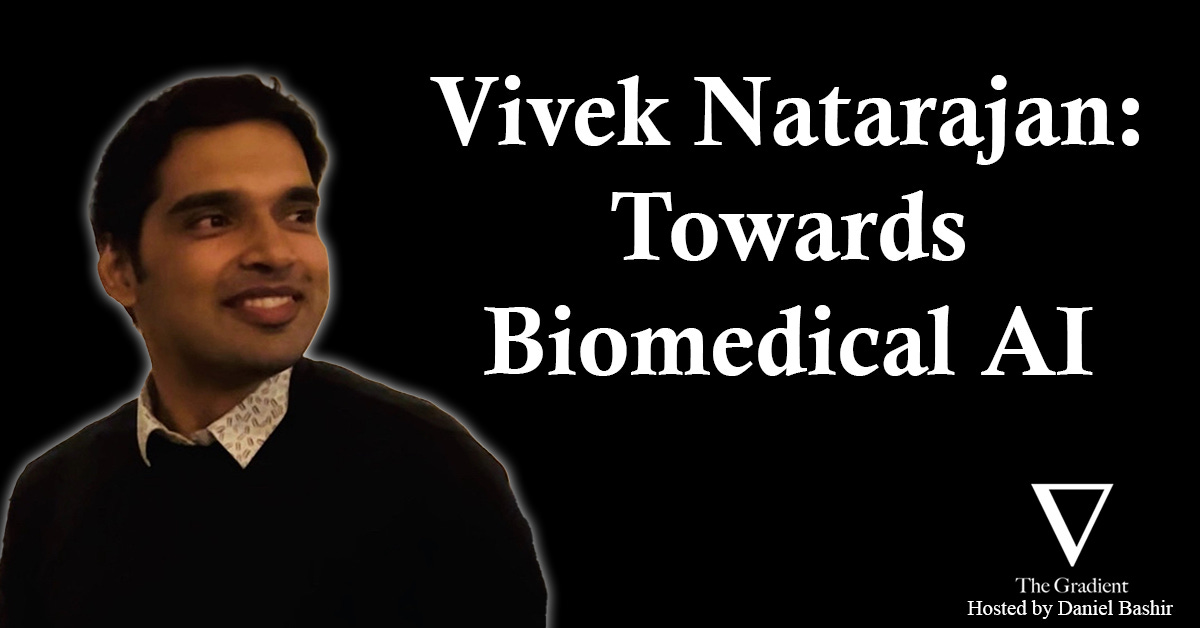
Vivek Natarajan: Towards Biomedical AI [not-audio_url] [/not-audio_url]

Duration: 1:55:03
Episode 126I spoke with Vivek Natarajan about:* Improving access to medical knowledge with AI* How an LLM for medicine should behave* Aspects of training Med-PaLM and AMIE* How to facilitate appropriate amounts of trust…
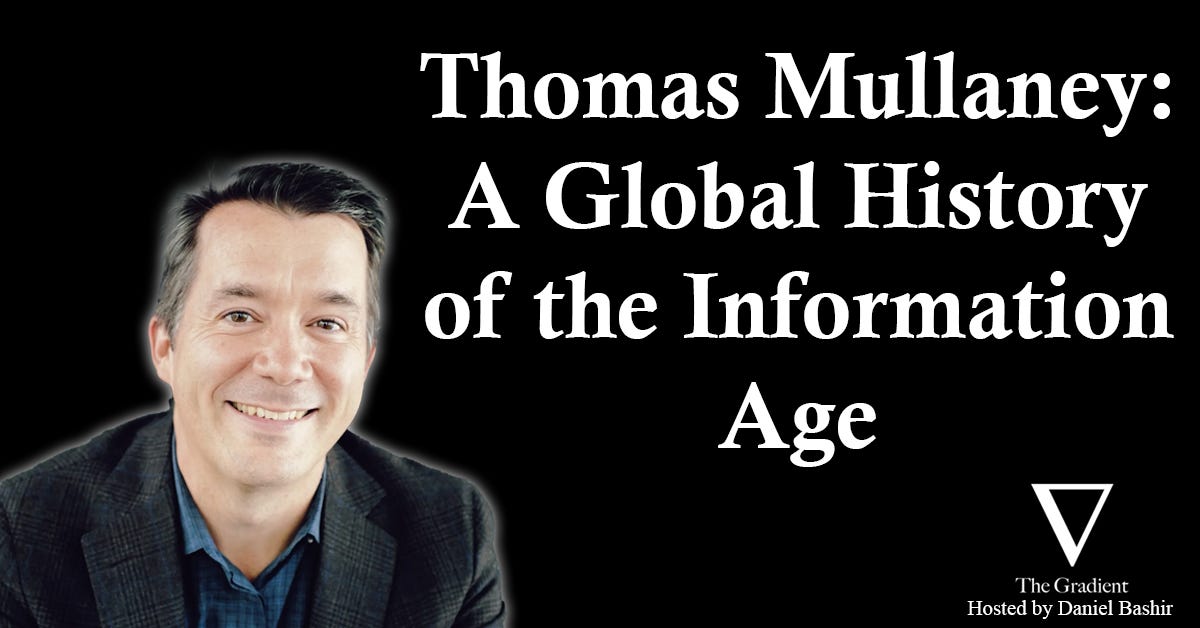
Thomas Mullaney: A Global History of the Information Age [not-audio_url] [/not-audio_url]

Duration: 1:43:45
Episode 125False universalism freaks me out. It doesn’t freak me out as a first principle because of epistemic violence; it freaks me out because it works. I spoke with Professor Thomas Mullaney about:* Telling stories a…
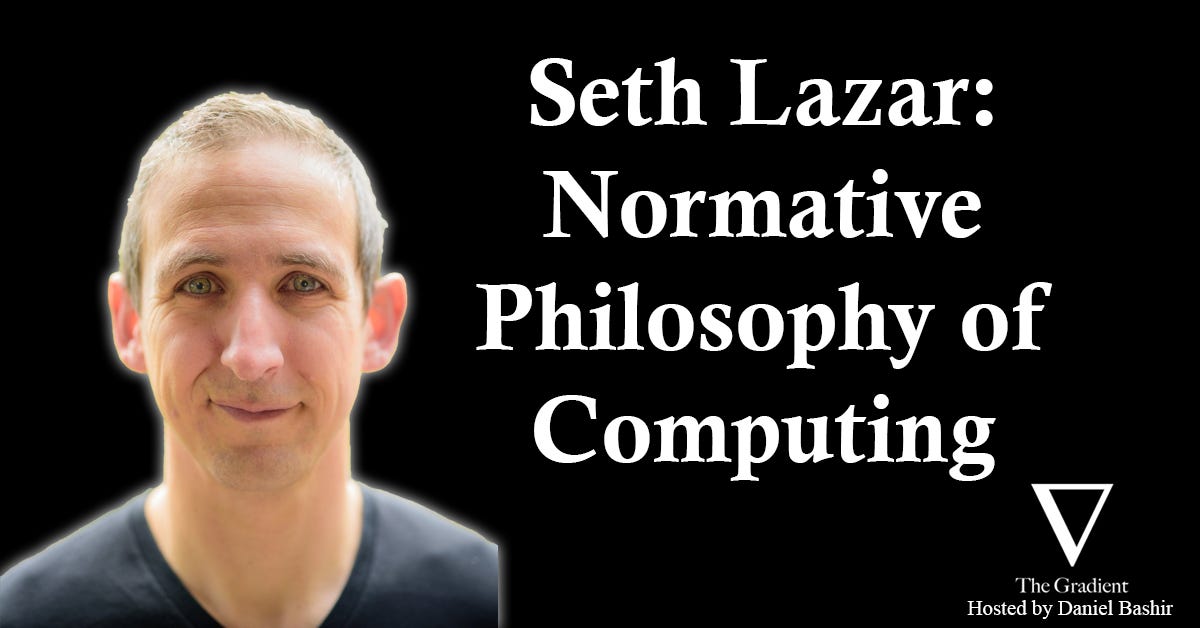
Seth Lazar: Normative Philosophy of Computing [not-audio_url] [/not-audio_url]

Duration: 1:50:17
Episode 124You may think you’re doing a priori reasoning, but actually you’re just over-generalizing from your current experience of technology.I spoke with Professor Seth Lazar about:* Why managing near-term and long-te…
Suhail Doshi: The Future of Computer Vision [not-audio_url] [/not-audio_url]

Duration: 1:08:07
Episode 123I spoke with Suhail Doshi about:* Why benchmarks aren’t prepared for tomorrow’s AI models* How he thinks about artists in a world with advanced AI tools* Building a unified computer vision model that can gener…
Azeem Azhar: The Exponential View [not-audio_url] [/not-audio_url]

Duration: 1:46:25
Episode 122I spoke with Azeem Azhar about:* The speed of progress in AI* Historical context for some of the terminology we use and how we think about technology* What we might want our future to look likeAzeem is an entr…
David Thorstad: Bounded Rationality and the Case Against Longtermism [not-audio_url] [/not-audio_url]

Duration: 2:19:02
Episode 122I spoke with Professor David Thorstad about:* The practical difficulties of doing interdisciplinary work* Why theories of human rationality should account for boundedness, heuristics, and other cognitive limit…
Michael Sipser: Problems in the Theory of Computation [not-audio_url] [/not-audio_url]

Duration: 1:28:21
In episode 119 of The Gradient Podcast, Daniel Bashir speaks to Professor Michael Sipser.Professor Sipser is the Donner Professor of Mathematics and member of the Computer Science and Artificial Intelligence Laboratory a…