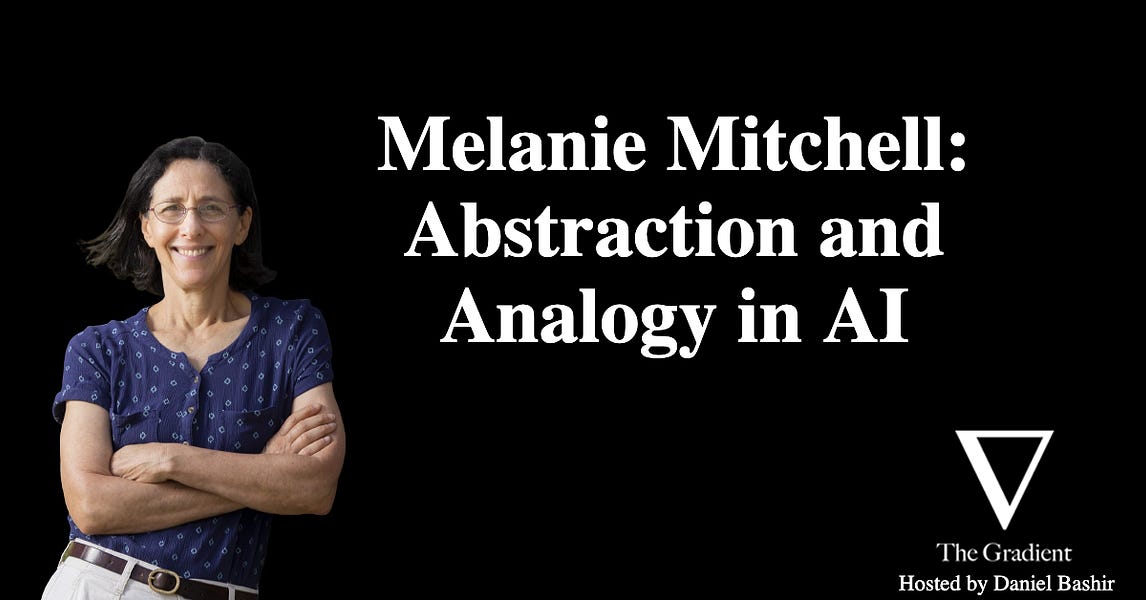
Melanie Mitchell: Abstraction and Analogy in AI

Melanie Mitchell: Abstraction and Analogy in AI

Author: Daniel Bashir December 15, 2022 Duration: 54:47

Have suggestions for future podcast guests (or other feedback)? Let us know here!

In episode 53 of The Gradient Podcast, Daniel Bashir speaks to Professor Melanie Mitchell.

Professor Mitchell is the Davis Professor at the Santa Fe Institute. Her research focuses on conceptual abstraction, analogy-making, and visual recognition in AI systems. She is the author or editor of six books and her work spans the fields of AI, cognitive science, and complex systems. Her latest book is Artificial Intelligence: A Guide for Thinking Humans

Subscribe to The Gradient Podcast:  Apple Podcasts  | Spotify | Pocket Casts | RSSFollow The Gradient on Twitter

Outline:

* (00:00) Intro

* (02:20) Melanie’s intro to AI

* (04:35) Melanie’s intellectual influences, AI debates over time

* (10:50) We don’t have the right metrics for empirical study in AI

* (15:00) Why AI is Harder than we Think: the four fallacies

* (20:50) Difficulties in understanding what’s difficult for machines vs humans

* (23:30) Roles for humanlike and non-humanlike intelligence

* (27:25) Whether “intelligence” is a useful word

* (31:55) Melanie’s thoughts on modern deep learning advances, brittleness

* (35:35) Abstraction, Analogies, and their role in AI

* (38:40) Concepts as analogical and what that means for cognition

* (41:25) Where does analogy bottom out

* (44:50) Cognitive science approaches to concepts

* (45:20) Understanding how to form and use concepts is one of the key problems in AI

* (46:10) Approaching abstraction and analogy, Melanie’s work / the Copycat architecture

* (49:50) Probabilistic program induction as a promising approach to intelligence

* (52:25) Melanie’s advice for aspiring AI researchers

* (54:40) Outro

Links:

* Melanie’s homepage and Twitter

* Papers

* Difficulties in AI, hype cycles

* Why AI is Harder than we think

* The Debate Over Understanding in AI’s Large Language Models

* What Does It Mean for AI to Understand?

* Abstraction, analogies, and reasoning

* Abstraction and Analogy-Making in Artificial Intelligence

* Evaluating understanding on conceptual abstraction benchmarks


Get full access to The Gradient at thegradientpub.substack.com/subscribe

Hosted by Daniel Bashir, The Gradient: Perspectives on AI moves beyond surface-level headlines to explore the intricate machinery and human ideas shaping artificial intelligence. Each episode is built on a foundation of deep research, leading to conversations that are both technically substantive and broadly accessible. You'll hear from researchers, engineers, and philosophers who are actively building and critiquing our technological future, discussing not just how AI systems work, but the larger implications of their integration into society. This isn't about speculative hype; it's a grounded examination of real progress, persistent challenges, and ethical considerations from those on the front lines. The discussions peel back layers on topics like model architecture, policy, and the fundamental science behind the algorithms becoming part of our daily lives. For anyone curious about the substance behind the buzz-whether you have a technical background or are simply keen to understand a defining technology of our age-this podcast offers a crucial and thoughtful resource. Tune in for a consistently detailed and nuanced take that treats artificial intelligence with the complexity it deserves.

Author: Language: English Episodes: 100

The Gradient: Perspectives on AI
Podcast Episodes
Ted Gibson: The Structure and Purpose of Language [not-audio_url] [/not-audio_url]

Duration: 2:13:24
In episode 107 of The Gradient Podcast, Daniel Bashir speaks to Professor Ted Gibson.Ted is a Professor of Cognitive Science at MIT. He leads the TedLab, which investigates why languages look the way they do; the relatio…
Eric Jang: AI is Good For You [not-audio_url] [/not-audio_url]

Duration: 1:29:57
In episode 105 of The Gradient Podcast, Daniel Bashir speaks to Eric Jang.Have suggestions for future podcast guests (or other feedback)? Let us know here or reach us at editor@thegradient.pubSubscribe to The Gradient Po…
2023 in AI, with Nathan Benaich [not-audio_url] [/not-audio_url]

Duration: 1:35:37
In episode 104 of The Gradient Podcast, Daniel Bashir speaks to Nathan Benaich.Nathan is Founder and General Partner at Air Street Capital, a VC firm focused on investing in AI-first technology and life sciences companie…
Kathleen Fisher: DARPA and AI for National Security [not-audio_url] [/not-audio_url]

Duration: 46:16
In episode 103 of The Gradient Podcast, Daniel Bashir speaks to Dr. Kathleen Fisher.As the director of DARPA’s Information Innovation Office (I2O), Dr. Kathleen Fisher oversees a portfolio that includes most of the agenc…
Peter Tse: The Neuroscience of Consciousness and Free Will [not-audio_url] [/not-audio_url]

Duration: 2:24:04
In episode 102 of The Gradient Podcast, Daniel Bashir speaks to Peter Tse.Professor Tse is a Professor of Cognitive Neuroscience and chair of the department of Psychological and Brain Sciences at Dartmouth College. His r…
Vera Liao: AI Explainability and Transparency [not-audio_url] [/not-audio_url]

Duration: 1:37:03
In episode 101 of The Gradient Podcast, Daniel Bashir speaks to Vera Liao.Vera is a Principal Researcher at Microsoft Research (MSR) Montréal where she is part of the FATE (Fairness, Accountability, Transparency, and Eth…
Thomas Dietterich: From the Foundations [not-audio_url] [/not-audio_url]

Duration: 2:01:57
In episode 100 of The Gradient Podcast, Daniel Bashir speaks to Professor Thomas Dietterich.Professor Dietterich is Distinguished Professor Emeritus in the School of Electrical Engineering and Computer Science at Oregon…
Martin Wattenberg: ML Visualization and Interpretability [not-audio_url] [/not-audio_url]

Duration: 1:42:05
In episode 99 of The Gradient Podcast, Daniel Bashir speaks to Professor Martin Wattenberg.Professor Wattenberg is a professor at Harvard and part-time member of Google Research’s People + AI Research (PAIR) initiative,…