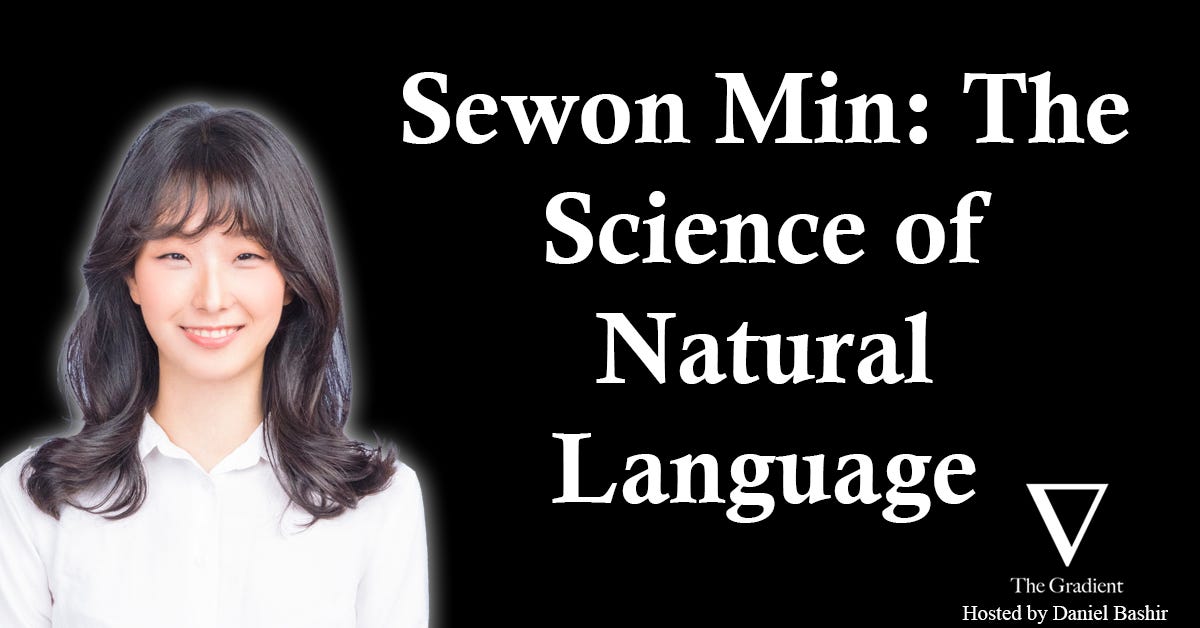
Sewon Min: The Science of Natural Language

Sewon Min: The Science of Natural Language

Author: Daniel Bashir March 23, 2023 Duration: 1:42:44

In episode 65 of The Gradient Podcast, Daniel Bashir speaks to Sewon Min.

Sewon is a fifth-year PhD student in the NLP group at the University of Washington, advised by Hannaneh Hajishirzi and Luke Zettlemoyer. She is a part-time visiting researcher at Meta AI and a recipient of the JP Morgan PhD Fellowship. She has previously spent time at Google Research and Salesforce research.

Have suggestions for future podcast guests (or other feedback)? Let us know here!

Subscribe to The Gradient Podcast:  Apple Podcasts  | Spotify | Pocket Casts | RSSFollow The Gradient on Twitter

Outline:

* (00:00) Intro

* (03:00) Origin Story

* (04:20) Evolution of Sewon’s interests, question-answering and practical NLP

* (07:00) Methodology concerns about benchmarks

* (07:30) Multi-hop reading comprehension

* (09:30) Do multi-hop QA benchmarks actually measure multi-hop reasoning?

* (12:00) How models can “cheat” multi-hop benchmarks

* (13:15) Explicit compositionality

* (16:05) Commonsense reasoning and background information

* (17:30) On constructing good benchmarks

* (18:40) AmbigQA and ambiguity

* (22:20) Types of ambiguity

* (24:20) Practical possibilities for models that can handle ambiguity

* (25:45) FaVIQ and fact-checking benchmarks

* (28:45) External knowledge

* (29:45) Fact verification and “complete understanding of evidence”

* (31:30) Do models do what we expect/intuit in reading comprehension?

* (34:40) Applications for fact-checking systems

* (36:40) Intro to in-context learning (ICL)

* (38:55) Example of an ICL demonstration

* (40:45) Rethinking the Role of Demonstrations and what matters for successful ICL

* (43:00) Evidence for a Bayesian inference perspective on ICL

* (45:00) ICL + gradient descent and what it means to “learn”

* (47:00) MetaICL and efficient ICL

* (49:30) Distance between tasks and MetaICL task transfer

* (53:00) Compositional tasks for language models, compositional generalization

* (55:00) The number and diversity of meta-training tasks

* (58:30) MetaICL and Bayesian inference

* (1:00:30) Z-ICL: Zero-Shot In-Context Learning with Pseudo-Demonstrations

* (1:02:00) The copying effect

* (1:03:30) Copying effect for non-identical examples

* (1:06:00) More thoughts on ICL

* (1:08:00) Understanding Chain-of-Thought Prompting

* (1:11:30) Bayes strikes again

* (1:12:30) Intro to Sewon’s text retrieval research

* (1:15:30) Dense Passage Retrieval (DPR)

* (1:18:40) Similarity in QA and retrieval

* (1:20:00) Improvements for DPR

* (1:21:50) Nonparametric Masked Language Modeling (NPM)

* (1:24:30) Difficulties in training NPM and solutions

* (1:26:45) Follow-on work

* (1:29:00) Important fundamental limitations of language models

* (1:31:30) Sewon’s experience doing a PhD

* (1:34:00) Research challenges suited for academics

* (1:35:00) Joys and difficulties of the PhD

* (1:36:30) Sewon’s advice for aspiring PhDs

* (1:38:30) Incentives in academia, production of knowledge

* (1:41:50) Outro

Links:

* Sewon’s homepage and Twitter

* Papers

* Solving and re-thinking benchmarks

* Multi-hop Reading Comprehension through Question Decomposition and Rescoring / Compositional Questions Do Not Necessitate Multi-hop Reasoning

* AmbigQA: Answering Ambiguous Open-domain Questions

* FaVIQ: FAct Verification from Information-seeking Questions

* Language Modeling

* Rethinking the Role of Demonstrations

* MetaICL: Learning to Learn In Context

* Towards Understanding CoT Prompting

* Z-ICL: Zero-Shot In-Context Learning with Pseudo-Demonstrations

* Text representation/retrieval

* Dense Passage Retrieval

* Nonparametric Masked Language Modeling


Get full access to The Gradient at thegradientpub.substack.com/subscribe
Hosted by Daniel Bashir, The Gradient: Perspectives on AI moves beyond surface-level headlines to explore the intricate machinery and human ideas shaping artificial intelligence. Each episode is built on a foundation of deep research, leading to conversations that are both technically substantive and broadly accessible. You'll hear from researchers, engineers, and philosophers who are actively building and critiquing our technological future, discussing not just how AI systems work, but the larger implications of their integration into society. This isn't about speculative hype; it's a grounded examination of real progress, persistent challenges, and ethical considerations from those on the front lines. The discussions peel back layers on topics like model architecture, policy, and the fundamental science behind the algorithms becoming part of our daily lives. For anyone curious about the substance behind the buzz-whether you have a technical background or are simply keen to understand a defining technology of our age-this podcast offers a crucial and thoughtful resource. Tune in for a consistently detailed and nuanced take that treats artificial intelligence with the complexity it deserves.
Author: Language: English Episodes: 100

The Gradient: Perspectives on AI
Podcast Episodes
Judy Fan: Reverse Engineering the Human Cognitive Toolkit [not-audio_url] [/not-audio_url]

Duration: 1:32:39
Episode 136I spoke with Judy Fan about:* Our use of physical artifacts for sensemaking* Why cognitive tools can be a double-edged sword* Her approach to scientific inquiry and how that approach has developedEnjoy—and let…
L.M. Sacasas: The Questions Concerning Technology [not-audio_url] [/not-audio_url]

Duration: 1:47:20
Episode 135I spoke with L. M. Sacasas about:* His writing and intellectual influences* The value of asking hard questions about technology and our relationship to it* What happens when we decide to outsource skills and c…
Pete Wolfendale: The Revenge of Reason [not-audio_url] [/not-audio_url]

Duration: 2:52:57
Episode 134I spoke with Pete Wolfendale about:* The flaws in longtermist thinking* Selections from his new book, The Revenge of Reason* Metaphysics* What philosophy has to say about reason and AIEnjoy—and let me know wha…
Peter Lee: Computing Theory and Practice, and GPT-4's Impact [not-audio_url] [/not-audio_url]

Duration: 1:01:48
Episode 133I spoke with Peter Lee about:* His early work on compiler generation, metacircularity, and type theory* Paradoxical problems* GPT-4s impact, Microsoft’s “Sparks of AGI” paper, and responses and criticismEnjoy—…
Manuel & Lenore Blum: The Conscious Turing Machine [not-audio_url] [/not-audio_url]

Duration: 2:23:04
Episode 132I spoke with Manuel and Lenore Blum about:* Their early influences and mentors* The Conscious Turing Machine and what theoretical computer science can tell us about consciousnessEnjoy—and let me know what you…
Kevin Dorst: Against Irrationalist Narratives [not-audio_url] [/not-audio_url]

Duration: 2:15:21
Episode 131I spoke with Professor Kevin Dorst about:* Subjective Bayesianism and epistemology foundations* What happens when you’re uncertain about your evidence* Why it’s rational for people to polarize on political mat…
David Pfau: Manifold Factorization and AI for Science [not-audio_url] [/not-audio_url]

Duration: 2:00:52
Episode 130I spoke with David Pfau about:* Spectral learning and ML* Learning to disentangle manifolds and (projective) representation theory* Deep learning for computational quantum mechanics* Picking and pursuing resea…
Sergiy Nesterenko: Automating Circuit Board Design [not-audio_url] [/not-audio_url]

Duration: 1:03:35
Episode 128I spoke with Sergiy Nesterenko about:* Developing an automated system for designing PCBs* Difficulties in human and automated PCB design* Building a startup at the intersection of different areas of expertiseB…