It's the Feast of
St. Raymond Nonnatus,
3rd Class, with the color of
White. In this episode: the meditation: "The Ritual Of the Miracle", today's news from the Church: ""I am the one you seek!"", a preview of the Sermon: "The Virtue of Obedience", and today's thought from the Archbishop Marcel Lefebvre.
Have feedback or questions about the DD or our other shows?
podcast@sspx.org
Sources Used Today:
- "The Ritual Of the Miracle" — From the Assumption to Advent
- ""I am the one you seek!"" (FSSPX.news)
- "The Virtue of Obedience" (SSPX Sermons)
- The Spiritual Life — Archbishop Marcel Lefebvre (Angelus Press)
Please support our new project, the Archbishop Lefebvre Biography Audiobook:
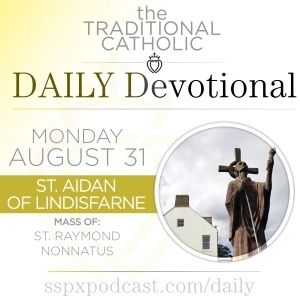
Saint Aidan of Lindisfarne helped bring Christianity to northern England, and one of the best things about his story is that he got the job because somebody else was apparently terrible at it.
In the seventh century, King Oswald of Northumbria wanted his newly recovered kingdom evangelized. He asked the monks of Iona in Scotland to send a missionary. Their first choice returned frustrated, complaining that the Northumbrians were stubborn and practically impossible to teach.
Aidan listened and suggested that perhaps the missionary had simply expected too much too quickly. Maybe, he said, the people needed the "milk of simpler teaching" before they were ready for stronger things.
The monks apparently looked around the room and thought:
Fine. You go.
So Aidan went.
And he was exactly the right man.
King Oswald gave him the island of Lindisfarne, just off the Northumbrian coast. There Aidan founded a monastery in 635 that became one of the great centers of Christianity in medieval Britain.
At first, there was a language problem.
Aidan spoke Irish.
The Northumbrians spoke Old English.
So Oswald, who had learned Irish during his years of exile, sometimes sat beside Aidan and translated his preaching for the people. It's a wonderful image: the king acting as interpreter for the missionary bishop.
Aidan's own missionary method was remarkably personal. He preferred walking rather than riding horseback because it allowed him to stop and talk with ordinary people along the road. If they were Christians, he encouraged them. If they weren't, he gently introduced them to the faith.
Someone eventually gave him a fine horse so he could travel more efficiently.
Aidan gave it away to a poor man.
When the donor complained, Aidan reportedly asked why the son of a mare should be valued more highly than a son of God.
That pretty much ended the discussion.
Aidan also used gifts from wealthy people to ransom slaves, and some of those freed men later became his students and eventually priests.
His monastery at Lindisfarne became known as Holy Island, and its influence continued long after Aidan's death. Missionaries trained there traveled throughout England establishing churches and monasteries. Later, Lindisfarne would produce the magnificent Lindisfarne Gospels, one of the treasures of medieval Christian art.
Visitors can still reach Holy Island today by a tidal causeway. Twice each day, the sea covers the road completely, temporarily cutting the island off from the mainland. Pilgrims have to check the tide tables before crossing, which somehow feels appropriate for a place where monks once built their lives around rhythms of prayer and nature.
Aidan died in 651, leaning against the outside wall of a church near Bamburgh.
He had arrived among people another missionary considered hopeless.
He simply approached them differently.
Saint Aidan of Lindisfarne, gentle Apostle of Northumbria and friend of the poor, pray for us.
- - - - - -
Explore more:
What is the SSPX Podcast?
The SSPX Podcast is produced by Angelus Press, which has as its mission the fortification of traditional Catholics so that they can defend the Faith, and reaching out to those who have not yet found Tradition.
What is the SSPX?
The main goal of the Society of Saint Pius X is to preserve the Catholic Faith in its fullness and purity, to teach its truths, and to diffuse its virtues, especially through the Roman Catholic priesthood.
Authentic spiritual life, the sacraments, and the traditional liturgy are its primary means of bringing this life of grace to souls.
Although the traditional Latin Mass is the most visible and public expression of the work of the Society, we are committed to defending Catholic Tradition in its entirety: all of Catholic doctrine and morals as the Church has always defended them. What people need is the Catholic Faith, without compromise, with all the truth and beauty which accompanies it.
https://sspx.org