It's the Feast of
XVII Sun of Pentecost,
2nd Class, with the color of
Green. In this episode: the meditation: "Jesus Christ, Son of God", today's news from the Church: "Preconception Genetic Screening: A New Form of Eugenics?", and today's thought from the Archbishop Marcel Lefebvre.
Have feedback or questions about the DD or our other shows?
podcast@sspx.org
Sources Used Today:
- "Jesus Christ, Son of God" — From the Assumption to Advent
- "Preconception Genetic Screening: A New Form of Eugenics?" (FSSPX.news)
- The Spiritual Life — Archbishop Marcel Lefebvre (Angelus Press)
Please support our new project, the Archbishop Lefebvre Biography Audiobook:
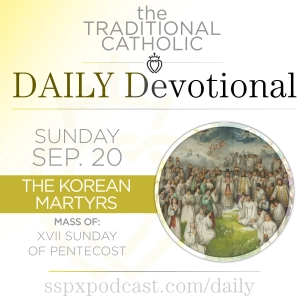
The story of the Korean Martyrs begins in a way that's almost unique in Catholic history.
Christianity reached Korea before missionaries did.
During the eighteenth century, Korean scholars traveling to China encountered Catholic books written by Jesuit missionaries. They brought them home and began studying Christianity on their own. A small group became convinced that the faith was true.
There was just one problem.
They didn't have any priests.
So Korean lay Catholics began teaching one another, baptizing converts, gathering for prayer, and building an underground Church largely by themselves. When they eventually learned more about how the Church actually worked, they wrote to the Bishop of Beijing essentially saying: please send us a priest.
That request became increasingly dangerous.
Korean society was built around Confucian customs, including ancestral rites that Catholics came to understand they could not participate in as religious worship. Christianity also taught that every person possessed equal dignity before God, an idea that could unsettle a rigid social hierarchy.
Persecution followed.
Over the next century, thousands of Korean Catholics were killed.
Among the best known was Saint Andrew Kim Taegon, the first native Korean Catholic priest. His journey to ordination was incredible. Because there was no seminary in Korea, he secretly traveled hundreds of miles to Macau, studied for the priesthood, was ordained in Shanghai, and then slipped back into Korea to serve Catholics in hiding.
He lasted about a year.
Andrew was arrested in 1846, tortured, and beheaded at only twenty-five.
Another remarkable figure was Saint Paul Chong Hasang, a layman who repeatedly crossed into China seeking priests for Korea. He even wrote directly to the pope asking for help establishing a permanent Catholic mission.
He was eventually executed too.
What makes the Korean Martyrs especially striking is the variety among them.
They included priests and laypeople, nobles and servants, husbands and wives, elderly believers and teenagers. Some families lost several generations.
And yet the underground Church survived.
When religious freedom finally began emerging in the late nineteenth century, missionaries discovered something astonishing: Catholic communities had continued praying, baptizing children, teaching the faith, and waiting for priests through decades of persecution.
Today, several major shrines around Seoul preserve their memory, especially the sites where executions took place along the Han River.
The Korean Church wasn't originally built around a missionary arriving from somewhere else.
It began with ordinary laypeople reading books, discovering the Catholic faith, and deciding it was worth risking everything to keep it.
Holy Martyrs of Korea, courageous priests, families, and lay apostles who kept the faith alive, pray for us.
- - - - - -
Explore more:
What is the SSPX Podcast?
The SSPX Podcast is produced by Angelus Press, which has as its mission the fortification of traditional Catholics so that they can defend the Faith, and reaching out to those who have not yet found Tradition.
What is the SSPX?
The main goal of the Society of Saint Pius X is to preserve the Catholic Faith in its fullness and purity, to teach its truths, and to diffuse its virtues, especially through the Roman Catholic priesthood.
Authentic spiritual life, the sacraments, and the traditional liturgy are its primary means of bringing this life of grace to souls.
Although the traditional Latin Mass is the most visible and public expression of the work of the Society, we are committed to defending Catholic Tradition in its entirety: all of Catholic doctrine and morals as the Church has always defended them. What people need is the Catholic Faith, without compromise, with all the truth and beauty which accompanies it.
https://sspx.org