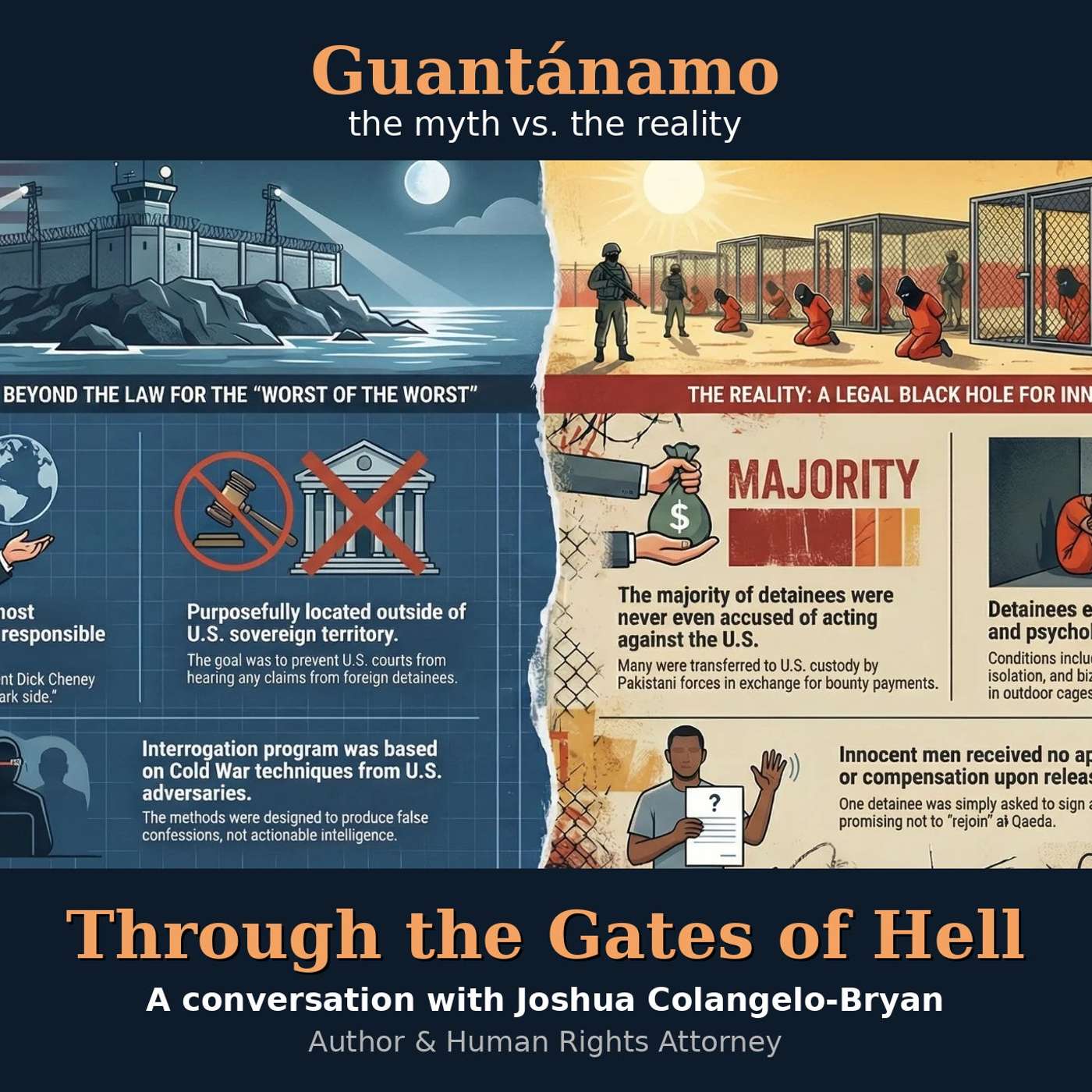

Guantanamo: The Myth vs the Reality
Dick Cheney died four weeks ago, but his dark legacy lives on—quite literally—at Guantanamo Bay. The human rights lawyer Joshua Colangelo-Bryan was among the first attorneys to enter the notorious prison in 2004, and what he found there shattered every official justification for its existence. The “worst of the worst”? Most detainees were never even accused of acting against America. Many were simply sold to the Americans for bounties. The sophisticated interrogation program? Techniques copied from Chinese and Soviet methods designed to extract false confessions, not intelligence. In his new book Through the Gates of Hell, Colangelo-Bryan tells the story of his unlikely friendship with Jaber Mohammed, a Bahraini detainee who spent years in captivity for the crime of being an Arab man in the wrong place (Afghanistan) at the wrong time (post 9/11). Released without apology or compensation—just a form asking him not to “rejoin” organizations he’d never belonged to—Jaber now lives in Saudi Arabia with four children, focusing less on bitterness and more on those rare moments when American guards showed him unexpected kindness. As the Trump administration revives the “worst of the worst” rhetoric against immigrants and once again sends people to Guantanamo, Colangelo-Bryan’s account is a warning from recent history: demonize a racial or religious group, and you will inevitably destroy innocent lives. The gates of hell have once again been opened. Will they ever be closed?
This is a public episode. If you'd like to discuss this with other subscribers or get access to bonus episodes, visit keenon.substack.com/subscribe
MinaLima on The Art of Designing the Graphics For the Harry Potter and Fantastic Beast Films
There's More to Life Than Politics: Orville Schell's Fictional Message to Xi Jinping
Kristin Keffeler: Why Do We Care About the Scions of Wealthy American Families Struggling to Find Purpose?
Josiah Ober: In a Time of Hostility Toward Reason and Science, What Can the Ancient Greeks Teach us About the Value of Rationality?
Michael J. Wolf: If AI, Web3.0, and the Metaverse Are Utopian Pipe Dreams, What Internet Innovation Can Actually Help Save the World?
Robert Draper on Weapons of Mass Distraction: How the Republican Party Lost Its Mind After the January 6 Insurrection
Bruce Davis: Do the Oscars Have a Future in an Age of Superhero Sequels and Prequels?
Shahan Mufti: How the 1977 Siege of Washington Marks the Beginning of Our Preoccupation With "Terrorist" Violence and Real-Time News
Andrew Koppelman: How American Libertarianism Became the Delusional Ideology of Greedy, Selfish Capitalists
Fred Hogge on An Icy Truth: How We've Used Cold to Transform Humanity and Destroy the Environment
Roger Ballen: Why Good Photography Should Get Underneath Our Skin and Assault Us
Michael P. Leiter: Why the Latest Battle Between Elon Musk and Twitter Works Is Part of a Bigger War About Burnout and the Need to Manage People's Relationships With Their Jobs
Gary Marcus: Why Smart Machines Will Probably Never Replicate the Human Act of Writing and How Writers Should View AI Suspiciously —"Like a Hawk"