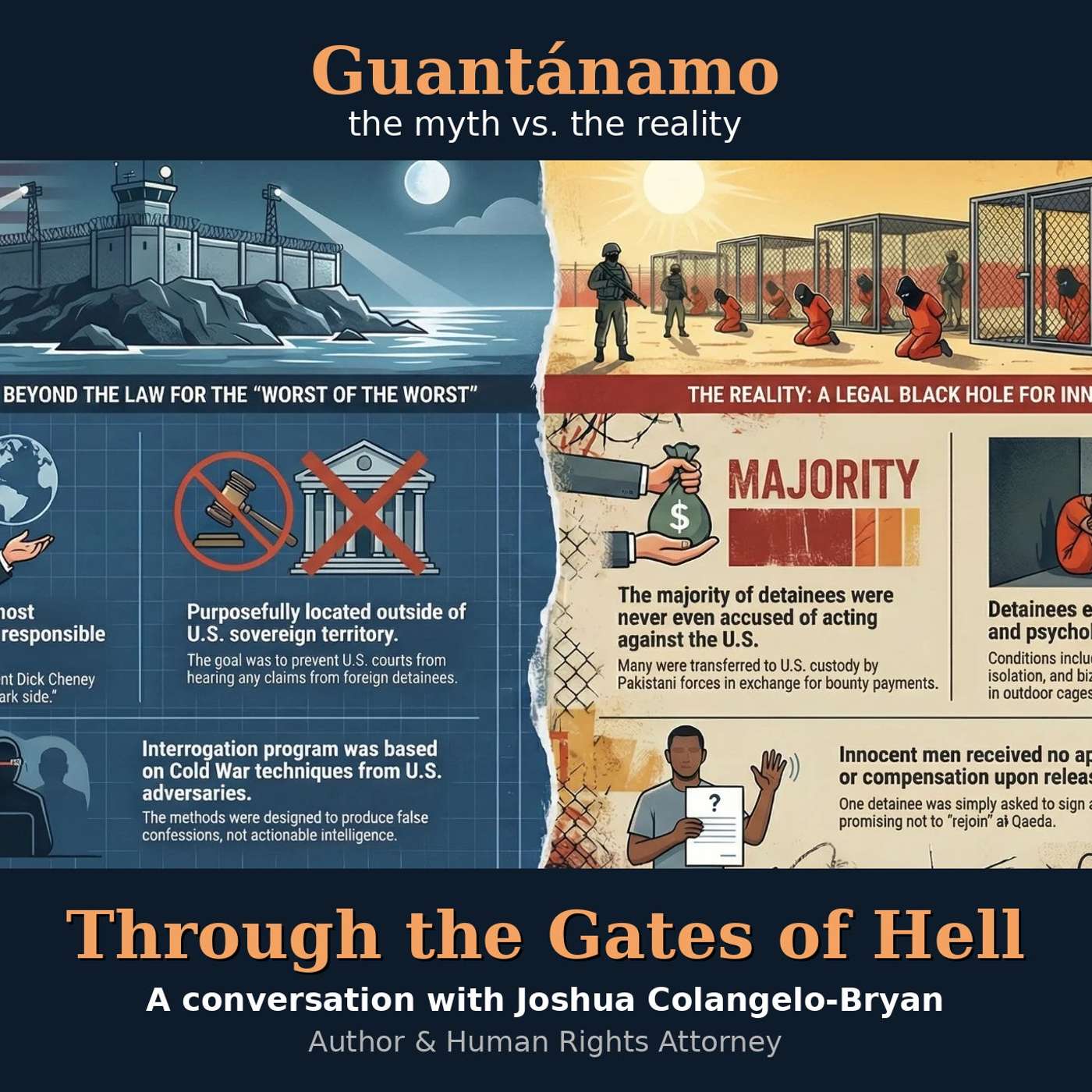

Guantanamo: The Myth vs the Reality
Dick Cheney died four weeks ago, but his dark legacy lives on—quite literally—at Guantanamo Bay. The human rights lawyer Joshua Colangelo-Bryan was among the first attorneys to enter the notorious prison in 2004, and what he found there shattered every official justification for its existence. The “worst of the worst”? Most detainees were never even accused of acting against America. Many were simply sold to the Americans for bounties. The sophisticated interrogation program? Techniques copied from Chinese and Soviet methods designed to extract false confessions, not intelligence. In his new book Through the Gates of Hell, Colangelo-Bryan tells the story of his unlikely friendship with Jaber Mohammed, a Bahraini detainee who spent years in captivity for the crime of being an Arab man in the wrong place (Afghanistan) at the wrong time (post 9/11). Released without apology or compensation—just a form asking him not to “rejoin” organizations he’d never belonged to—Jaber now lives in Saudi Arabia with four children, focusing less on bitterness and more on those rare moments when American guards showed him unexpected kindness. As the Trump administration revives the “worst of the worst” rhetoric against immigrants and once again sends people to Guantanamo, Colangelo-Bryan’s account is a warning from recent history: demonize a racial or religious group, and you will inevitably destroy innocent lives. The gates of hell have once again been opened. Will they ever be closed?
This is a public episode. If you'd like to discuss this with other subscribers or get access to bonus episodes, visit keenon.substack.com/subscribe
Ahmed White: What the Early 20th Century War on Radical Workers Tells Us About the Struggle Between Labor and Capital in America Today
Allegra Goodman : What Happens When a Novelist "Overparents" Their Characters? How a Fictional Creation Can Fight Back Against Their Helicopter Author`
Aaron De Smet: Why, In Our Age of Permanent Volatility, We Need to Foster a Zen-Like "Deliberate Calm"
Daniel Akst: Why World War II's Greatest Generation Should Be Celebrated As Much For Its Heroic Pacifism As For Its Selfless Sacrifice in Battle
Chitra Banerjee Divakaruni: Why All Writers, Especially Novelists, Are Political: Which Is Why Novels Can Change the World
Esther Woolfson: The Most Disturbing of All Human Sins? How We Live With Other Creatures
Chloe Sorvino: How the Multi-Trillion Dollar Industrial Meat Complex is Bad For Our Species and Our Planet
Michael Kimmelman: Why New York Should Be Savored on Foot Rather Than From an Automobile
David Marchick: What Do FDR, Trump, and Lincoln Have in Common? The Worst Transitions of Presidential Power in American History
Samantha Vérant: How to Live in France and Write Novels About Fine Food and Wine
Bob Blaisdell on When Chekhov Became Chekhov: How the Son of a Serf Became a Literary Genius
Lynne Twist: What Gandhi, Mandela, and Martin Luther King Can Teach Us About Living a Committed Life
Max Bazerman: Crypto, #MeToo, Theranos, and January 6: How We Enable the Unethical