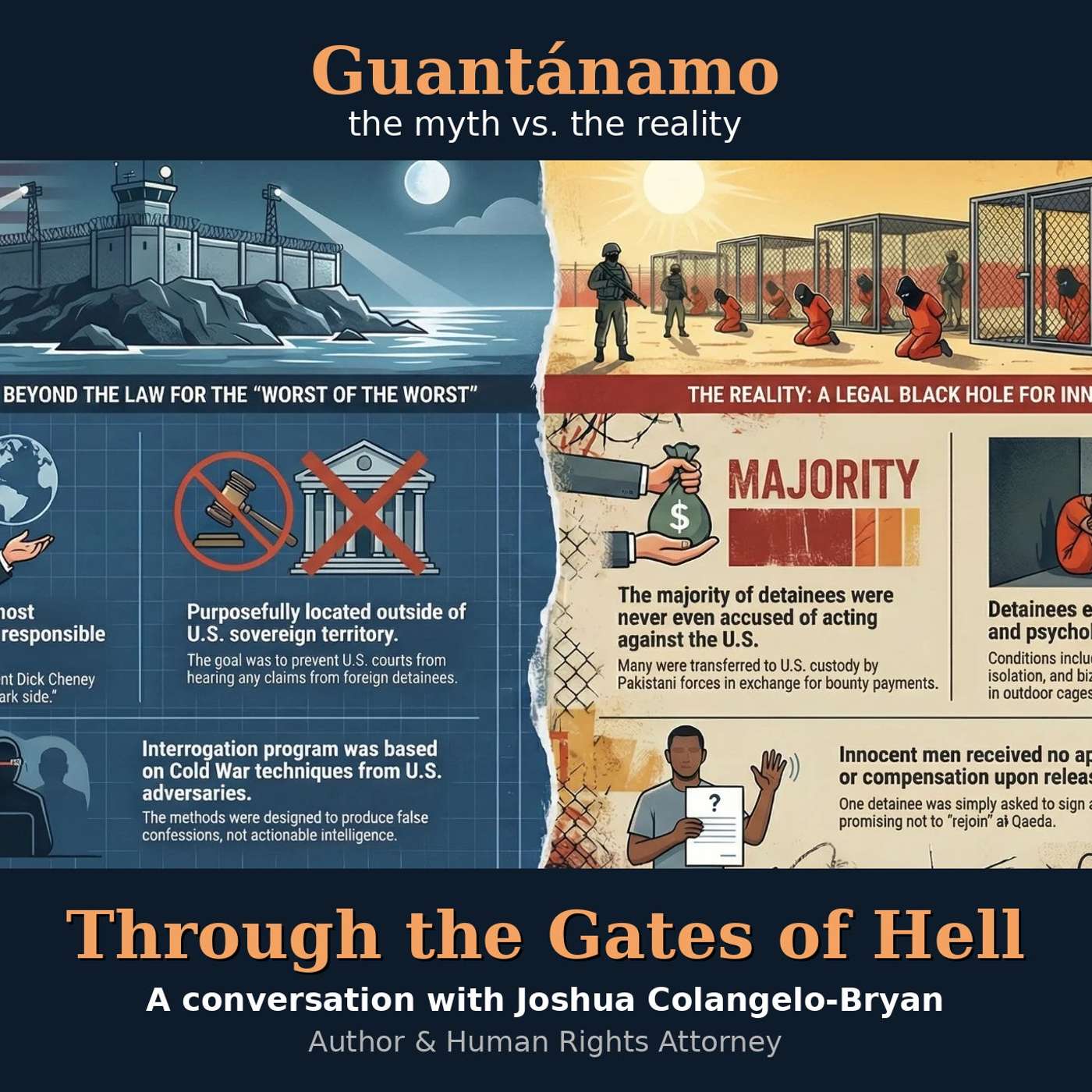

Guantanamo: The Myth vs the Reality
Dick Cheney died four weeks ago, but his dark legacy lives on—quite literally—at Guantanamo Bay. The human rights lawyer Joshua Colangelo-Bryan was among the first attorneys to enter the notorious prison in 2004, and what he found there shattered every official justification for its existence. The “worst of the worst”? Most detainees were never even accused of acting against America. Many were simply sold to the Americans for bounties. The sophisticated interrogation program? Techniques copied from Chinese and Soviet methods designed to extract false confessions, not intelligence. In his new book Through the Gates of Hell, Colangelo-Bryan tells the story of his unlikely friendship with Jaber Mohammed, a Bahraini detainee who spent years in captivity for the crime of being an Arab man in the wrong place (Afghanistan) at the wrong time (post 9/11). Released without apology or compensation—just a form asking him not to “rejoin” organizations he’d never belonged to—Jaber now lives in Saudi Arabia with four children, focusing less on bitterness and more on those rare moments when American guards showed him unexpected kindness. As the Trump administration revives the “worst of the worst” rhetoric against immigrants and once again sends people to Guantanamo, Colangelo-Bryan’s account is a warning from recent history: demonize a racial or religious group, and you will inevitably destroy innocent lives. The gates of hell have once again been opened. Will they ever be closed?
This is a public episode. If you'd like to discuss this with other subscribers or get access to bonus episodes, visit keenon.substack.com/subscribe
Maud Newton: How to Come to Terms With Troubling Ancestors
Isaac Fitzgerald: What's Wrong (And Right) With American Male Writers
Paul Tucker: What Chinese and American Statesmen Need to Do to Lessen Global Discord
Priyanka Kumar: How "Reading" Nature, Especially Birds, Enables Us to Transcend Ourselves
Ben Kesling: The Gut-Wrenching Story of One U.S. Army Unit's Experience in Afghanistan
Samantha Cole: How Sex Changed the Internet and the Internet Changed Sex
RJ Andrews: Why the Future of Publishing For One Start-Up Entrepreneur is High-End and Analog Books That Visualize Data
Lenore Andreson: How California is Pioneering the Reform of the American Criminal Justice System
Claudia Lux: Imagining a Kafkaesque Hell in Which There Is Only Jägermeister to Drink and the Devil Is a Corporate Bureaucrat
Henrietta Harrison on the 18th-Century China Question: The Perils of Translating Between Qing China and the British Empire
Greg Melville: How Cemeteries Reveal America's Most Hidden and Often Deadliest History
Paul Sexton: Perhaps the Most Remarkable Thing About Charlie Watts Was Just How Remarkably Ordinary He Was
Colin L. Read on Not the People's Money: Uncovering Bitcoin's Catastrophic Economic and Environmental Cost