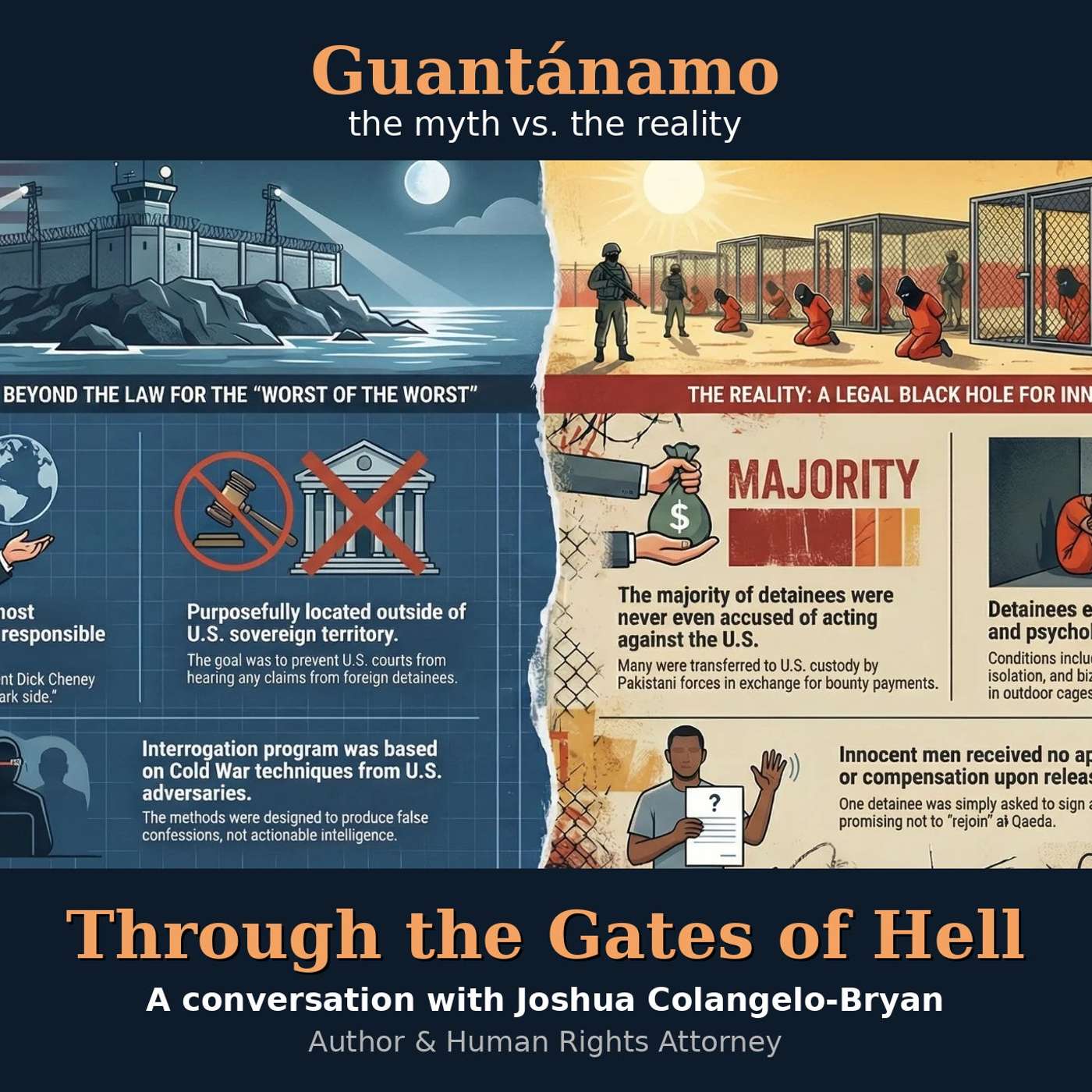

Guantanamo: The Myth vs the Reality
Dick Cheney died four weeks ago, but his dark legacy lives on—quite literally—at Guantanamo Bay. The human rights lawyer Joshua Colangelo-Bryan was among the first attorneys to enter the notorious prison in 2004, and what he found there shattered every official justification for its existence. The “worst of the worst”? Most detainees were never even accused of acting against America. Many were simply sold to the Americans for bounties. The sophisticated interrogation program? Techniques copied from Chinese and Soviet methods designed to extract false confessions, not intelligence. In his new book Through the Gates of Hell, Colangelo-Bryan tells the story of his unlikely friendship with Jaber Mohammed, a Bahraini detainee who spent years in captivity for the crime of being an Arab man in the wrong place (Afghanistan) at the wrong time (post 9/11). Released without apology or compensation—just a form asking him not to “rejoin” organizations he’d never belonged to—Jaber now lives in Saudi Arabia with four children, focusing less on bitterness and more on those rare moments when American guards showed him unexpected kindness. As the Trump administration revives the “worst of the worst” rhetoric against immigrants and once again sends people to Guantanamo, Colangelo-Bryan’s account is a warning from recent history: demonize a racial or religious group, and you will inevitably destroy innocent lives. The gates of hell have once again been opened. Will they ever be closed?
This is a public episode. If you'd like to discuss this with other subscribers or get access to bonus episodes, visit keenon.substack.com/subscribe
Alexander Rose on The Lion and the Fox: Two Rival Spies and the Secret Plot to Build a Confederate Army
David Fenton on Lessons From Fifty Years as a Progressive Agitator: Never Lie, Tell the Truth, Repeat Repeat Repeat
Ian Kershaw: The Eleven Men (and One Woman) Who Authored 20th-Century Europe
Richard McCarthy: What Japan Can Teach Urban Americans About Regenerating Rural Values and Practices
Steve Kemper: Could Pearl Harbor Have Been Avoided With More Skillful American Diplomacy?
Eduardo Halfon: Why "Writing" Has Nothing to Do With Being a "Writer"
Katherine Corcoran: How the 2012 Murder of a Mexican Journalist Should Be a Warning About Press Freedoms in America
Andrew Hill on the Sign of Our Financial Times: How 2022's Best Business Books Address the Challenges of Contemporary Global Capitalism
Shannon O'Neil on The Globalization Myth: Why Most Economics Is Regional
Travis Baldree: Want to Self-Publish Successfully? Write Fast, Leverage All Your Social Media Networks, and Prioritize Memorable Cover Art
John Mulholland on Inside High Noon: Why the Classic 1952 Movie Is As Relevant in America Today As It Was 70 Years Ago
Ellis Cose on Reckoning on Race: Why Can't America Escape Its Racist Past?
Adam Mendelsohn on What Was It Like to Be a Jew in Lincoln's Armies: Jewish Soldiers in the Civil War