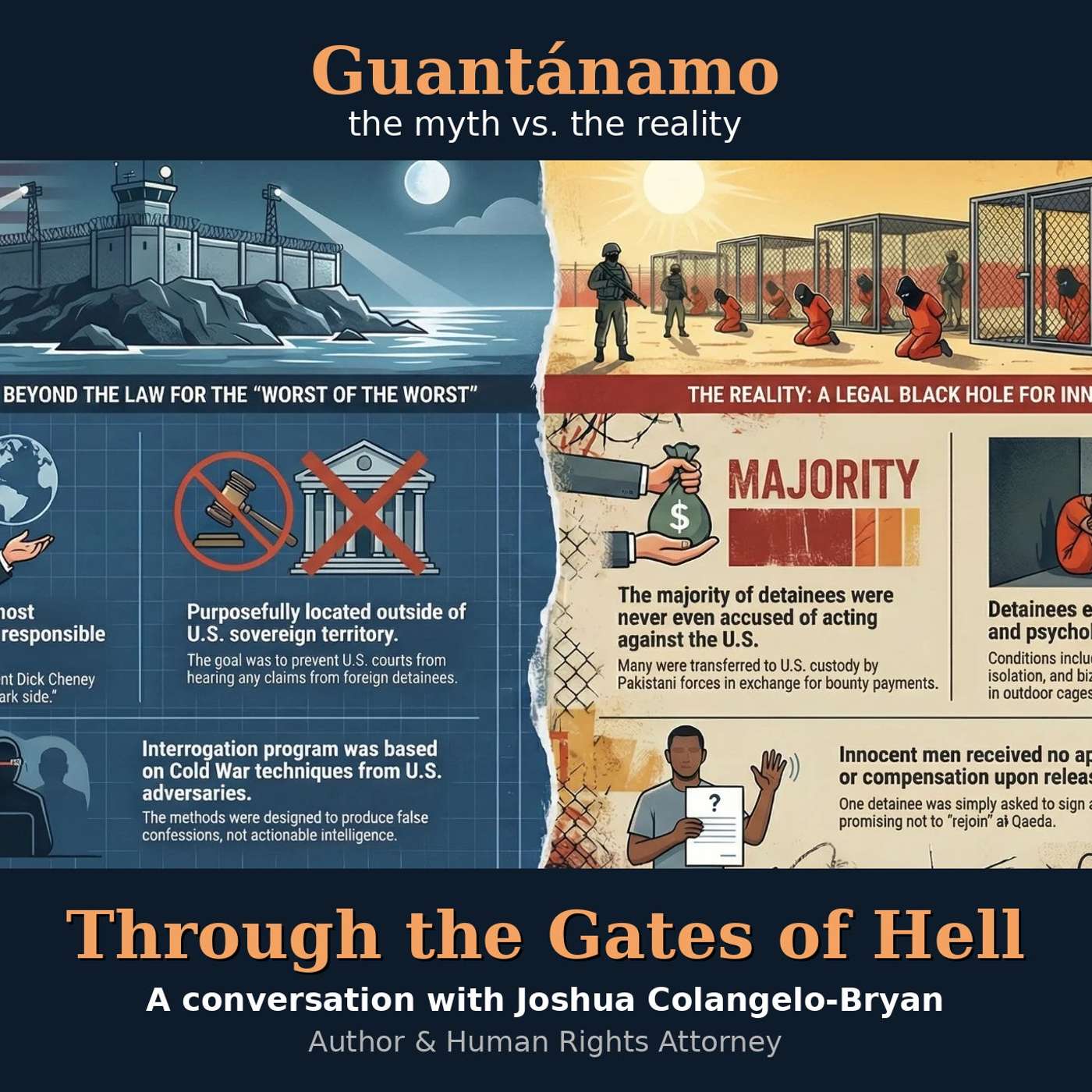
Guantanamo: The Myth vs the Reality
Dick Cheney died four weeks ago, but his dark legacy lives on—quite literally—at Guantanamo Bay. The human rights lawyer Joshua Colangelo-Bryan was among the first attorneys to enter the notorious prison in 2004, and what he found there shattered every official justification for its existence. The “worst of the worst”? Most detainees were never even accused of acting against America. Many were simply sold to the Americans for bounties. The sophisticated interrogation program? Techniques copied from Chinese and Soviet methods designed to extract false confessions, not intelligence. In his new book Through the Gates of Hell, Colangelo-Bryan tells the story of his unlikely friendship with Jaber Mohammed, a Bahraini detainee who spent years in captivity for the crime of being an Arab man in the wrong place (Afghanistan) at the wrong time (post 9/11). Released without apology or compensation—just a form asking him not to “rejoin” organizations he’d never belonged to—Jaber now lives in Saudi Arabia with four children, focusing less on bitterness and more on those rare moments when American guards showed him unexpected kindness. As the Trump administration revives the “worst of the worst” rhetoric against immigrants and once again sends people to Guantanamo, Colangelo-Bryan’s account is a warning from recent history: demonize a racial or religious group, and you will inevitably destroy innocent lives. The gates of hell have once again been opened. Will they ever be closed?
This is a public episode. If you'd like to discuss this with other subscribers or get access to bonus episodes, visit keenon.substack.com/subscribe
Modern Britain and all that caper: Jonathan Coe on British chocolate, the Royal Family and its decision to marry the wrong Super Power
An Old Story Told Differently: Bethanne Patrick on 8 books reimagining the experience of first generation immigrants
Against the Romance of Transformation: Leon Weiseltier on America's love affair with the promise of personal and social change
Normalizing China: Gilles Guiheux on China's very ordinary history between 1949 and today
Against Green Capitalism: Charles Derber on how big money fuels extinction and what we can do about it
No, Men aren't Angels: Peter Slen on why the Federalist Papers is one of the ten books that has most shaped America
Dumb devices, dumb bureaucrats and dumb entrepreneurs: Keith Teare on FTC chair Lina Khan, FTX founder Sam Bankman-Fried and why the iPhone is on the brink of becoming radically more intelligent
Why Disorder may be the New Order: Jason Pack on how the global system itself has gone rogue and no longer conforms with the textbooks
Why Artificial Intelligence will make us smarter: W. Russell Neuman presents AI as a progressive moment in human evolution
An Afterword to Words Themselves? Bethanne Patrick on six speculative novels which imagine a world saturated by AI
Should we punish innovation? Keith Teare on public and private investment markets, breaking up Google and paying to use X
The 10 books that have most shaped America: Peter Slen on Thomas Paine's COMMON SENSE
The White Man's version of Democracy in America? Brook Manville on the "Civic Bargain" that defines the history of democracy in western civilization