Guantanamo: The Myth vs the Reality
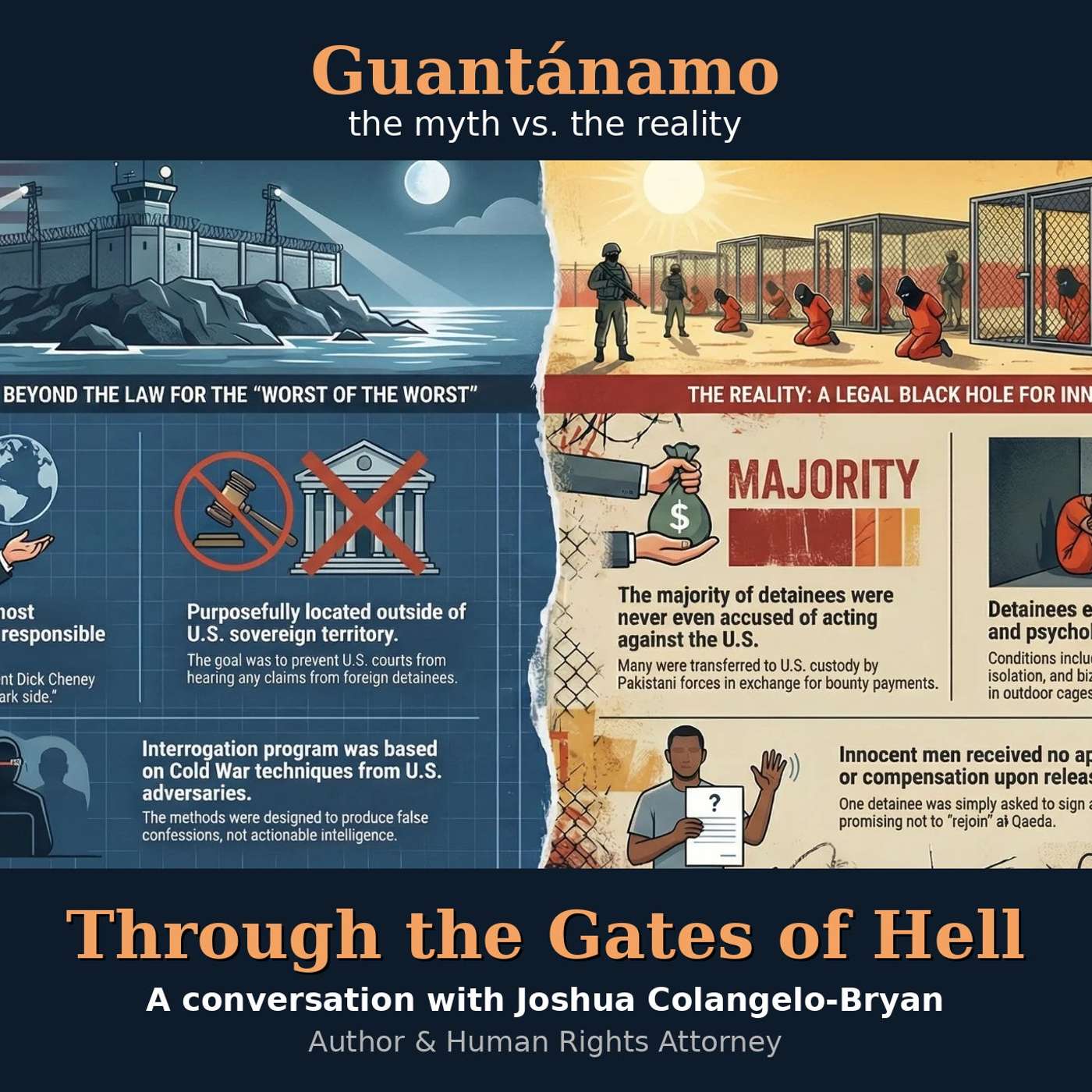
Dick Cheney died four weeks ago, but his dark legacy lives on—quite literally—at Guantanamo Bay. The human rights lawyer Joshua Colangelo-Bryan was among the first attorneys to enter the notorious prison in 2004, and what he found there shattered every official justification for its existence. The “worst of the worst”? Most detainees were never even accused of acting against America. Many were simply sold to the Americans for bounties. The sophisticated interrogation program? Techniques copied from Chinese and Soviet methods designed to extract false confessions, not intelligence. In his new book Through the Gates of Hell, Colangelo-Bryan tells the story of his unlikely friendship with Jaber Mohammed, a Bahraini detainee who spent years in captivity for the crime of being an Arab man in the wrong place (Afghanistan) at the wrong time (post 9/11). Released without apology or compensation—just a form asking him not to “rejoin” organizations he’d never belonged to—Jaber now lives in Saudi Arabia with four children, focusing less on bitterness and more on those rare moments when American guards showed him unexpected kindness. As the Trump administration revives the “worst of the worst” rhetoric against immigrants and once again sends people to Guantanamo, Colangelo-Bryan’s account is a warning from recent history: demonize a racial or religious group, and you will inevitably destroy innocent lives. The gates of hell have once again been opened. Will they ever be closed?
This is a public episode. If you'd like to discuss this with other subscribers or get access to bonus episodes, visit keenon.substack.com/subscribe
What the data tells us about the cancellation of the American mind: Greg Lukianoff on why today's cancel culture is as much of a threat to free speech as the McCarthyite Red Scare of the 1950s
Why an elite establishment economist is calling bullsh*t on the promise of the American dream: Jeff Fuhrer reveals the existential crisis of economic inequality now threatening the United States
Why Poland is still in therapy over its "complex" World War II history: Roger Moorhouse on the forgotten story of a Polish diplomatic rescue operation to save the lives of Polish Jews
How "responsible" was Benjamin Netanyahu for the events of October 7? Israel novelist Noa Yedlin on the worst thing that has happened to the Jewish people since the Holocaust
Broken bodies, broken homes, broken families & broken work: Alissa Quart reveals life on the edge in the world's richest country
How to resurrect the World's Greatest Detective: Sophie Hannah on her latest Agatha Christie sanctioned murder mystery HERCULE POIROT'S SILENT NIGHT
In Defense of Place: Seth Kaplan on how to repair American society, one zip code at a time
Should we celebrate or mourn technological abundance? Keith Teare weighs up the costs and benefits of abundant artificial intelligence
Why Oliver Wendell Holmes' book "Common Law" is most uncommon: Peter Slen on the 1881 legal classic that has profoundly shaped America
What is it about scientists that makes many of them so consensual and collaborative? Lorraine Daston explains how scientists have learned to cooperate with each other
Why the American Dream has turned into a nightmare for many Americans: Andrea Dobynes Wagner on life in the United States as a black woman with an invisible disability
Listening Once Again to Prozac: Peter D. Kramer offers a thirty year history of antidepressants and the remaking of the American self
The Impact of Small Things: Best-selling writer and Hollywood actress Annabelle Gurwitch on her experience of taking in a homeless couple in Los Angeles