Guantanamo: The Myth vs the Reality
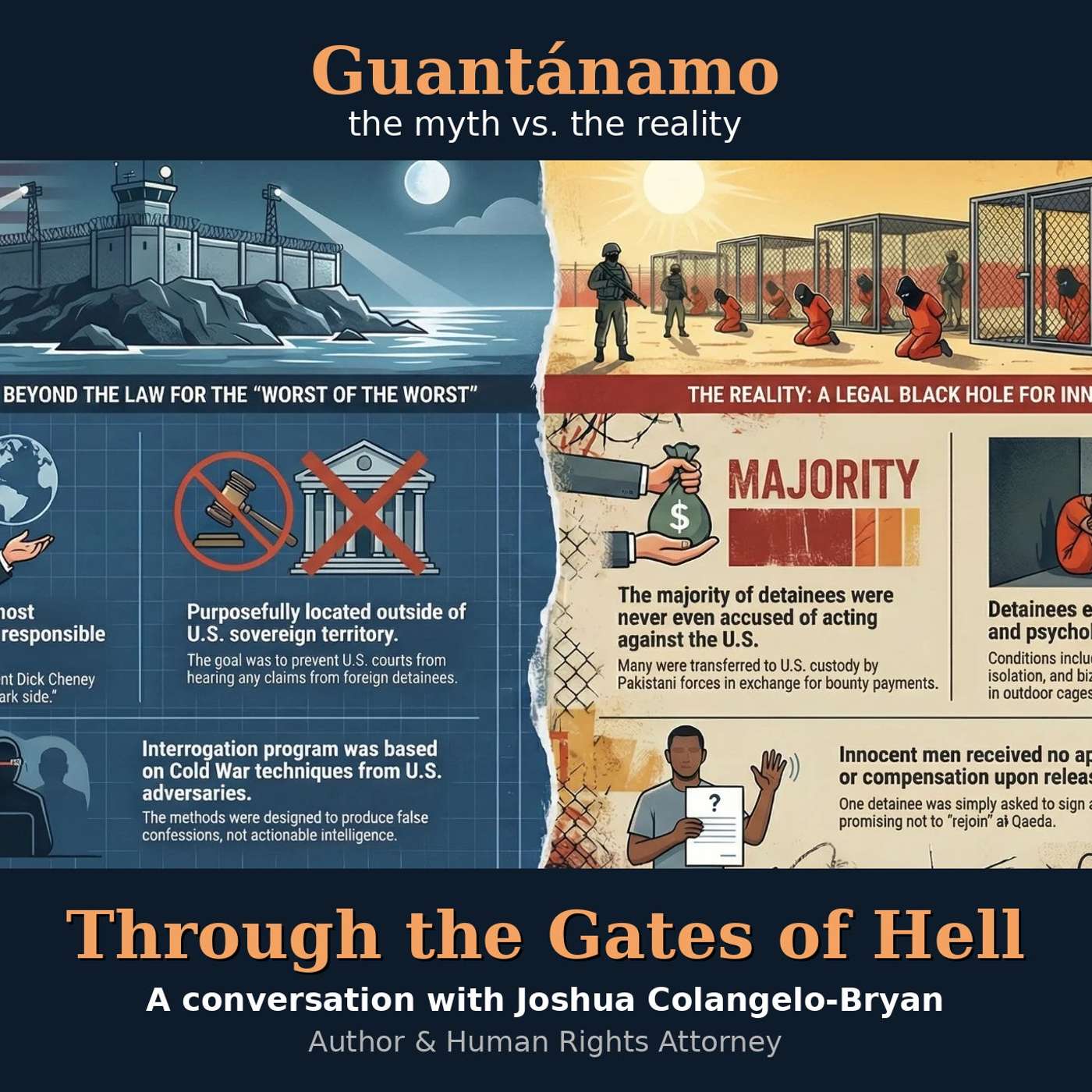
Dick Cheney died four weeks ago, but his dark legacy lives on—quite literally—at Guantanamo Bay. The human rights lawyer Joshua Colangelo-Bryan was among the first attorneys to enter the notorious prison in 2004, and what he found there shattered every official justification for its existence. The “worst of the worst”? Most detainees were never even accused of acting against America. Many were simply sold to the Americans for bounties. The sophisticated interrogation program? Techniques copied from Chinese and Soviet methods designed to extract false confessions, not intelligence. In his new book Through the Gates of Hell, Colangelo-Bryan tells the story of his unlikely friendship with Jaber Mohammed, a Bahraini detainee who spent years in captivity for the crime of being an Arab man in the wrong place (Afghanistan) at the wrong time (post 9/11). Released without apology or compensation—just a form asking him not to “rejoin” organizations he’d never belonged to—Jaber now lives in Saudi Arabia with four children, focusing less on bitterness and more on those rare moments when American guards showed him unexpected kindness. As the Trump administration revives the “worst of the worst” rhetoric against immigrants and once again sends people to Guantanamo, Colangelo-Bryan’s account is a warning from recent history: demonize a racial or religious group, and you will inevitably destroy innocent lives. The gates of hell have once again been opened. Will they ever be closed?
This is a public episode. If you'd like to discuss this with other subscribers or get access to bonus episodes, visit keenon.substack.com/subscribe
How the October 7 tragedy might turn out to be a game changer in a good way: Israeli writer Assaf Gavron on why we must "try again" to make peace in the Middle East
Six all-too-human books about AI: Bethane Patrick on the mavens, mavericks and mythology writing our smart machine future
This was the week that the world dramatically changed: Keith Teare celebrates the beginning of the end of the pre AI age
A classic novel that not only shaped America but also captured the authentic voice of the African-American South: Peter Slen on Zora Neale Hurston's "Their Eyes Were Watching God", an anthropological fiction set in a particularly rough period in American
Why genuine neutrality was mostly a myth in the Second World War: Neill Lochery on the flight of Nazi treasure through "neutral" countries after the war
How to write poetry on a smartphone: Best-selling poet and TikTok sensation Whitney Hanson on the anxiety of her generation and why social media makes physical events more "real"
The dark truth of Mexico as a mostly truant state terrorized by subsistence gangsters and haunted by hollow people: Azam Ahmed on the story of a missing daughter, a violent Cartel and a mother's quest for vengeance
Do great leaders make history or does history make great leaders? Moshik Temkin on the art of leadership from FDR, Malcolm X and MLK to Trump and Biden
How to accurately reconstruct the entire 13.9 billion year history of the universe: David Helfand on the power of atomic science to unveil the mysteries of unreachably remote time and space
Turning Mrs Dalloway into a novel set in the New York City of April 2017: Lisa Gornick on writing a New York story in the philistine age of the Taliban and Donald Trump
An Unprincipled Man for our Unprincipled Times: Rob Copeland on Ray Dalio, the billionaire Big Brother of Bridgewater Associates, the largest hedge fund on the planet
How early 21st century America resembles late 19th century Russia: John Gray on our post-liberal future
The double life of America's most notorious agent of betrayal: Major Garrett on Robert Hanssen, the FBI spy and weaver of a web of lies, both outrageously large and pathetically small