Guantanamo: The Myth vs the Reality
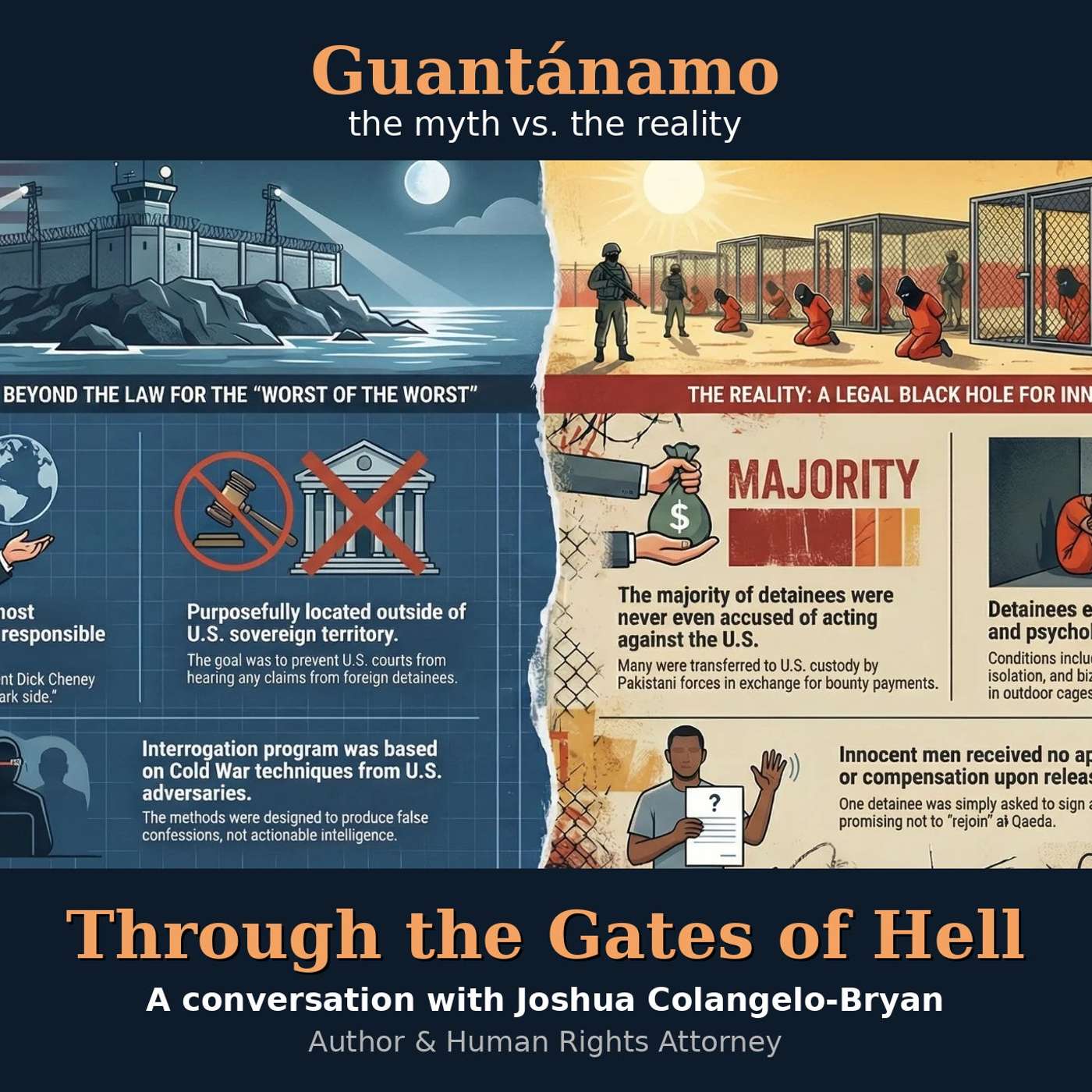
Dick Cheney died four weeks ago, but his dark legacy lives on—quite literally—at Guantanamo Bay. The human rights lawyer Joshua Colangelo-Bryan was among the first attorneys to enter the notorious prison in 2004, and what he found there shattered every official justification for its existence. The “worst of the worst”? Most detainees were never even accused of acting against America. Many were simply sold to the Americans for bounties. The sophisticated interrogation program? Techniques copied from Chinese and Soviet methods designed to extract false confessions, not intelligence. In his new book Through the Gates of Hell, Colangelo-Bryan tells the story of his unlikely friendship with Jaber Mohammed, a Bahraini detainee who spent years in captivity for the crime of being an Arab man in the wrong place (Afghanistan) at the wrong time (post 9/11). Released without apology or compensation—just a form asking him not to “rejoin” organizations he’d never belonged to—Jaber now lives in Saudi Arabia with four children, focusing less on bitterness and more on those rare moments when American guards showed him unexpected kindness. As the Trump administration revives the “worst of the worst” rhetoric against immigrants and once again sends people to Guantanamo, Colangelo-Bryan’s account is a warning from recent history: demonize a racial or religious group, and you will inevitably destroy innocent lives. The gates of hell have once again been opened. Will they ever be closed?
This is a public episode. If you'd like to discuss this with other subscribers or get access to bonus episodes, visit keenon.substack.com/subscribe
Eight literary tricks and treats to scare you this Halloween: Bethanne Patrick on "app-aritions", cultural ghosts and unfamiliarly familiar haunted houses
Why our cyborg AI future may already have arrived in the trained-on-jargon "person" of Sam Bankman-Fried: Hito Steyerl on pyramid schemes, on-boarding tools and the "mean" creativity of our AI age
Is the venture capital industry a big ponzi scheme? Keith Teare separates the hyperbole from the hysteria of VC techno-optimism
The American Shakespeare or trash of the veriest sort? Peter Slen on Mark Twain's ADVENTURES OF HUCKLEBERRY FINN, the adventurous story of a young man and young nation on a great and not-so-great adventure
A Graphic Diary of the War in Ukraine: Nora Krug on the contrasting realities of a Ukrainian journalist and a Russian artist in the first year of Russian invasion
The Dismal Science investigates that most dismal of things - economic inequality: Branko Milanovic on visions of inequality from the French Revolution to the end of the Cold War
That Sinking Feeling of Falling Out of the Middle Class: Ray Suarez on his fear of being poor in the America of the inegalitarian Twenties
Celebrating a transcendental photography of nature that blurs art and science: Photographer Anand Varma on his lifelong wonder with the natural world
How to stand up to the apocalypse: Peter Sarris on Justinian, the 6th century Byzantine ruler who confounded a narrative of decline
The Fruit of the Gods or of the Devil? Alexander Sammon on the sordid history of the avocado, the thirstiest fruit on the planet
Why Nineteen Eighty-Four wasn't really like Nineteen-Eighty Four: Sandra Newman on Julia, Winston Smith and the totalitarianism of gender that George Orwell ignored in his masculine dystopia
How to Reawaken the American Dream: David Leonhardt on unions, constitutional reform, immigration and the need for a progressive populism
Why Generative AI could make artists extinct: Karla Ortiz warns about the existential "theft" at the heart of the AI revolution