Guantanamo: The Myth vs the Reality
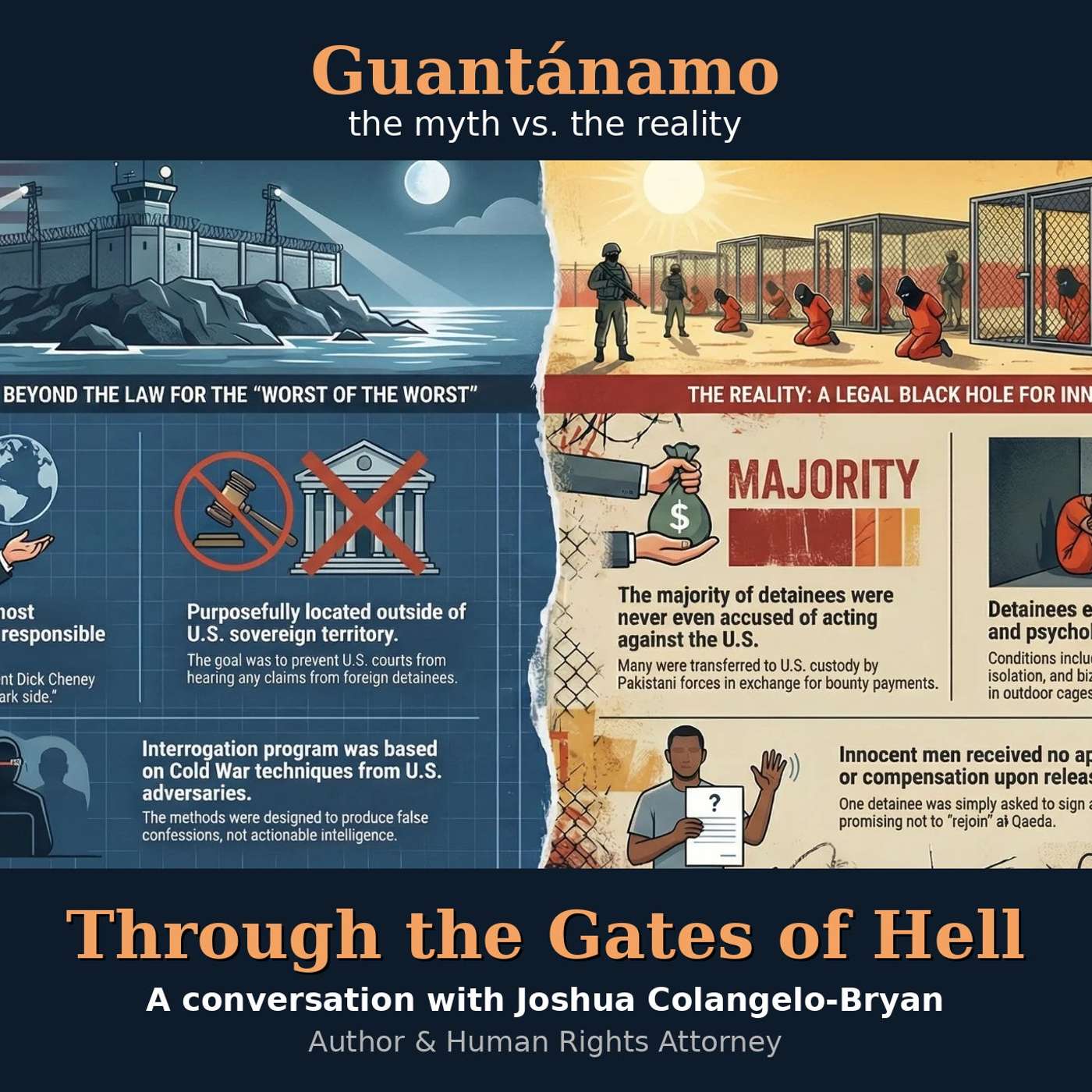
Dick Cheney died four weeks ago, but his dark legacy lives on—quite literally—at Guantanamo Bay. The human rights lawyer Joshua Colangelo-Bryan was among the first attorneys to enter the notorious prison in 2004, and what he found there shattered every official justification for its existence. The “worst of the worst”? Most detainees were never even accused of acting against America. Many were simply sold to the Americans for bounties. The sophisticated interrogation program? Techniques copied from Chinese and Soviet methods designed to extract false confessions, not intelligence. In his new book Through the Gates of Hell, Colangelo-Bryan tells the story of his unlikely friendship with Jaber Mohammed, a Bahraini detainee who spent years in captivity for the crime of being an Arab man in the wrong place (Afghanistan) at the wrong time (post 9/11). Released without apology or compensation—just a form asking him not to “rejoin” organizations he’d never belonged to—Jaber now lives in Saudi Arabia with four children, focusing less on bitterness and more on those rare moments when American guards showed him unexpected kindness. As the Trump administration revives the “worst of the worst” rhetoric against immigrants and once again sends people to Guantanamo, Colangelo-Bryan’s account is a warning from recent history: demonize a racial or religious group, and you will inevitably destroy innocent lives. The gates of hell have once again been opened. Will they ever be closed?
This is a public episode. If you'd like to discuss this with other subscribers or get access to bonus episodes, visit keenon.substack.com/subscribe
Five of the Non-Fictional Best: Bethanne Patrick picks her favorite non-fiction books for 2023
How Not To Age: Dr Michael Greger offers a simple dietary approach to getting healthier as we get older
Why it's time stop declaring war on everything: David Keen on the "Wreckonomics" of how we now find ourselves locked into so many failed economic, environmental and political policies
How our brains mirror the history of human evolution: Min W. Jung on the neuroscience of imagination and abstract thinking
A Return to Normal Abnormality in Silicon Valley: Keith Teare on why even some of the most highly capitalized AI start-ups are now running out of runway and will not survive
In Praise of Ineffective Altruism: Amy Schiller on how philanthropy went wrong and how to fix it
Should we let go of Philip Roth? Hannah Gold gets into Roth's mind, his hands and his followers
In Defense of Trash Talk: Rafi Kohan on Muhammed Ali, Babe Ruth, Michael Jordan, Elon Musk and why talking smack is as old as the Bible
Why even the smartest machine vision won't eliminate bias: Jill Walker Rettberg on how algorithms are changing the way we see and are seen by the world
When Language Was Up For Grabs: Ben Lerner warns against falling in love once again with the promise of digital technology to democratize language
The First Neo-Liberal or the Last Conservative? Jennifer Burns on Milton Friedman, the most controversial American economist of the 20th century
Why American humor isn't really being cancelled by the woke police: Kliph Nesteroff's history of showbiz and its perennial culture wars
Why all great geniuses are also rebels: Bulent Atalay on how Shakespeare, Da Vinci, Newton, Beethoven and Einstein all shared similarly transgressive minds