Guantanamo: The Myth vs the Reality
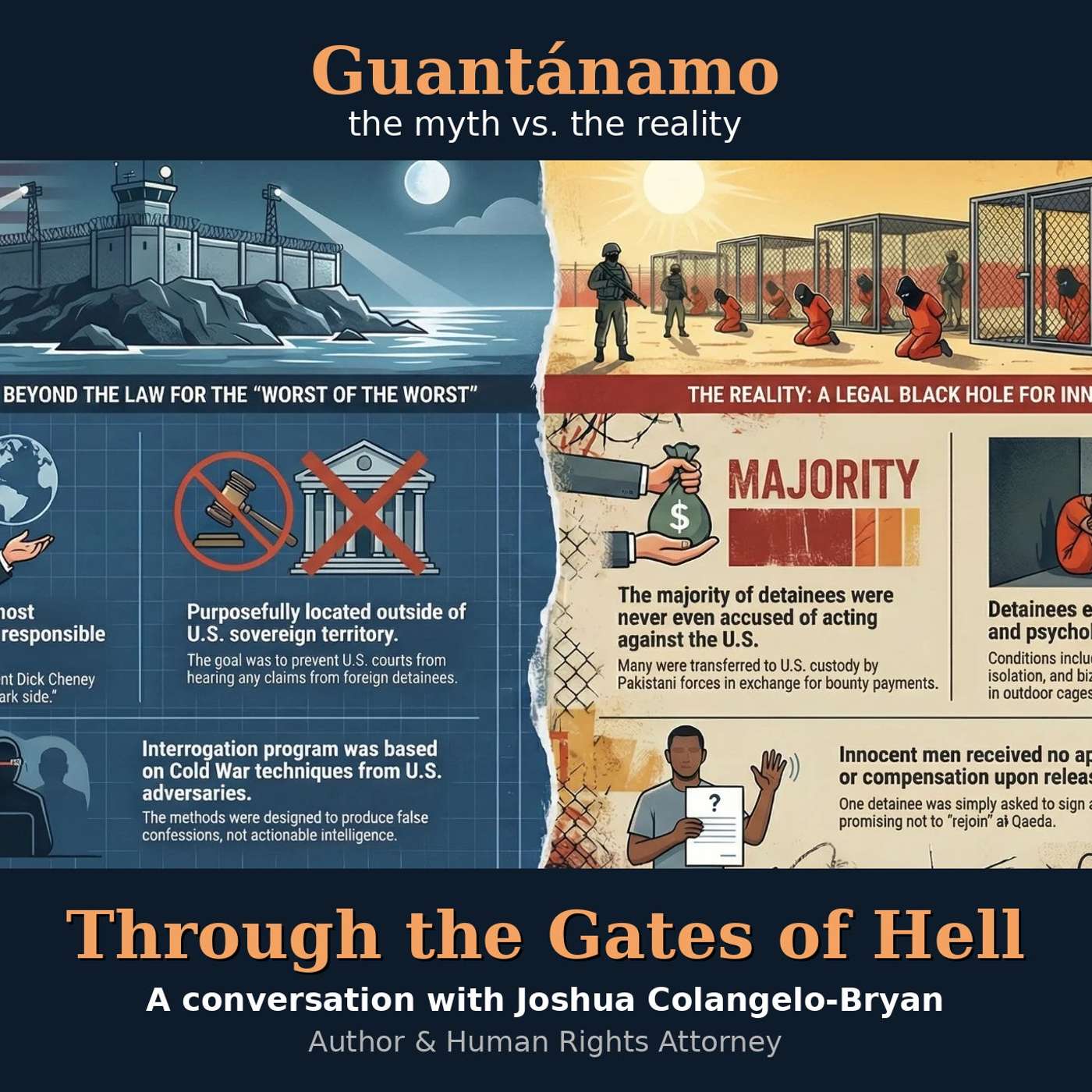
Dick Cheney died four weeks ago, but his dark legacy lives on—quite literally—at Guantanamo Bay. The human rights lawyer Joshua Colangelo-Bryan was among the first attorneys to enter the notorious prison in 2004, and what he found there shattered every official justification for its existence. The “worst of the worst”? Most detainees were never even accused of acting against America. Many were simply sold to the Americans for bounties. The sophisticated interrogation program? Techniques copied from Chinese and Soviet methods designed to extract false confessions, not intelligence. In his new book Through the Gates of Hell, Colangelo-Bryan tells the story of his unlikely friendship with Jaber Mohammed, a Bahraini detainee who spent years in captivity for the crime of being an Arab man in the wrong place (Afghanistan) at the wrong time (post 9/11). Released without apology or compensation—just a form asking him not to “rejoin” organizations he’d never belonged to—Jaber now lives in Saudi Arabia with four children, focusing less on bitterness and more on those rare moments when American guards showed him unexpected kindness. As the Trump administration revives the “worst of the worst” rhetoric against immigrants and once again sends people to Guantanamo, Colangelo-Bryan’s account is a warning from recent history: demonize a racial or religious group, and you will inevitably destroy innocent lives. The gates of hell have once again been opened. Will they ever be closed?
This is a public episode. If you'd like to discuss this with other subscribers or get access to bonus episodes, visit keenon.substack.com/subscribe
In defense of literary flyover country: Peter Slen on Willa Cather's "My Antonia", the 1918 novel that captured the ideal of immigrant middle America
Orwell and his women: Bethanne Patrick on new feminist takes on George Orwell - the man , the husband and the writer.
Guilty by seven crimes and death by a thousand verticals: Keith Teare on Sam Bankman-Fried and Palo Alto, Elon Musk and Rishi Sunak, and Space X and X
How to get more women in science right now: Lisa Munoz on implicit bias, leaky pipelines, tokenization and other explanations for the persistent gender gap in science
Did the KGB really invent the idea of the Palestinian nation in the 1960s? Pierre Rehov on Iranian financed sleeper-cells in US universities and why he admires Hamas' "evil mind"
Overcoming the politics of black grief and white grievance in America today: Juliet Hooker on why American democracy is in desperate need of an radical expansion of its political imagination
A remarkable American hero at a time in which many Americans are no longer comfortable with the heroic ideal: Ronald C. White on the life of Joshua Lawrence Chamberlain, the unlikely hero of Gettysburg
The problem with stories about the Holocaust is that they are told by the survivors: Daniel Finkelstein on the extraordinary coincidences enabling the survival of his mum and dad from both Hitler and Stalin
Zero to Zero: William Deresiewicz on what happens when the price of online content is driven down to zero
Where have all the Democrats gone? Ruy Teixeira on why the Democratic Party needs to tone down the volume on cultural issues if it's to rediscover its soul
How this month's "almost miraculous" Polish election might be a hopeful sign for democracy everywhere: Maciej Kisilowski on the promise and peril of representative democracy in a post authoritarian Poland
Does today's climate change crisis represent an existential threat to humanity? Antonello Provenzale contextualizes the contemporary crisis within a history of climate change from the earth origins to the Anthropocene
An enigmatic city teetering on the edge of the world: John Kampfner on Berlin, a city of ghosts and memories where he can still smell the Wall