Guantanamo: The Myth vs the Reality
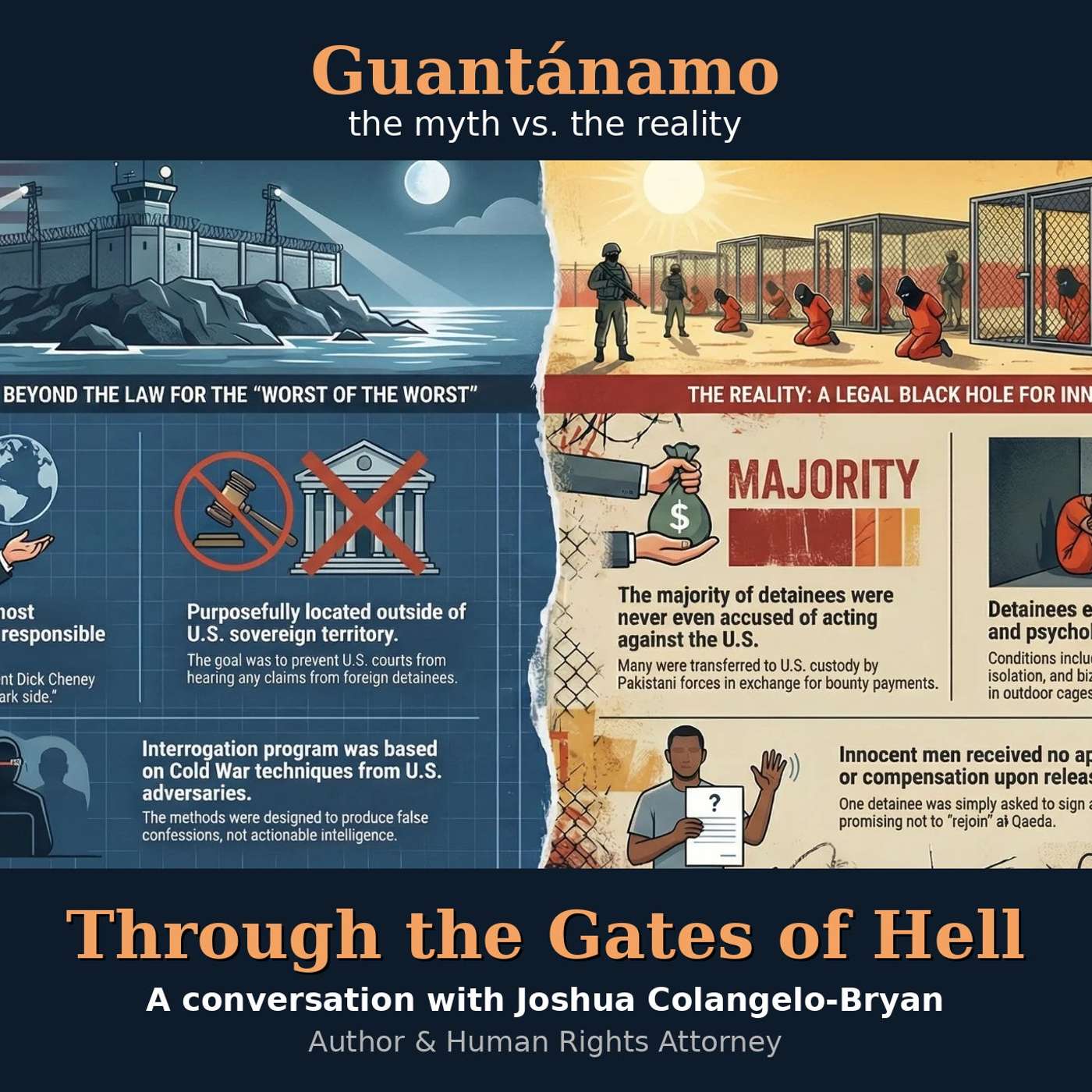
Dick Cheney died four weeks ago, but his dark legacy lives on—quite literally—at Guantanamo Bay. The human rights lawyer Joshua Colangelo-Bryan was among the first attorneys to enter the notorious prison in 2004, and what he found there shattered every official justification for its existence. The “worst of the worst”? Most detainees were never even accused of acting against America. Many were simply sold to the Americans for bounties. The sophisticated interrogation program? Techniques copied from Chinese and Soviet methods designed to extract false confessions, not intelligence. In his new book Through the Gates of Hell, Colangelo-Bryan tells the story of his unlikely friendship with Jaber Mohammed, a Bahraini detainee who spent years in captivity for the crime of being an Arab man in the wrong place (Afghanistan) at the wrong time (post 9/11). Released without apology or compensation—just a form asking him not to “rejoin” organizations he’d never belonged to—Jaber now lives in Saudi Arabia with four children, focusing less on bitterness and more on those rare moments when American guards showed him unexpected kindness. As the Trump administration revives the “worst of the worst” rhetoric against immigrants and once again sends people to Guantanamo, Colangelo-Bryan’s account is a warning from recent history: demonize a racial or religious group, and you will inevitably destroy innocent lives. The gates of hell have once again been opened. Will they ever be closed?
This is a public episode. If you'd like to discuss this with other subscribers or get access to bonus episodes, visit keenon.substack.com/subscribe
Why OpenAI could be worth $5 trillion by 2028: Keith Teare explains how OpenAI might already be the most valuable company on the planet
The Man Who Could See Around Corners: Peter Slen on Frederick Douglass and his 1845 autobiography about his life os an American slave
America in the Dillon era: Richard Aldous on Douglas Dillon and mainstream Republicanism in the Eisenhower, Kennedy and Johnson administrations
An American Gun for the age of Sandy Hook and Uvalde: Cameron McWhirter and Zusha Elinson on the history of the AR-15, an assault weapon that captures contemporary America's love affair with technology, freedom and guns
How to transform yourself from a good girl into a bad b***h: Lisa Carmen Wang's bad b***h business bible for taking charge of your body, boundaries and bank account
Why Food Stamps Work: Christopher Bosso's political history - and defense - of SNAP
Saving Bill Clinton's life and other tales from the operating theater: Craig R. Smith on his life as one of America's most celebrated heart surgeons
A New Deal to Save the Earth: John J. Berger outlines the three dimensions to solving the world's climate crisis
The Emotional Life of Populism in Israel: Eva Illouz on Netanyahu, Hamas and what the left has lost by not embracing the fear, disgust, resentment and love that determine democratic politics
The October weekend that changed the Middle East forever: Uri Kaufman compares the Yom Kippur war of October 1973 with the Simchat Torah war of October 2023
Tripping into our brave new psychedelic world: Andy Mitchell on his odyssey into the new reality of psychedelics
The Blood Years, then and now: Elana K. Arnold on book banning, book burning and what we can learn from Second World War books about good and evil
Disorder, Disorder, Disorder: Jason Pack and Alexandra Hall Hall order our disordered world