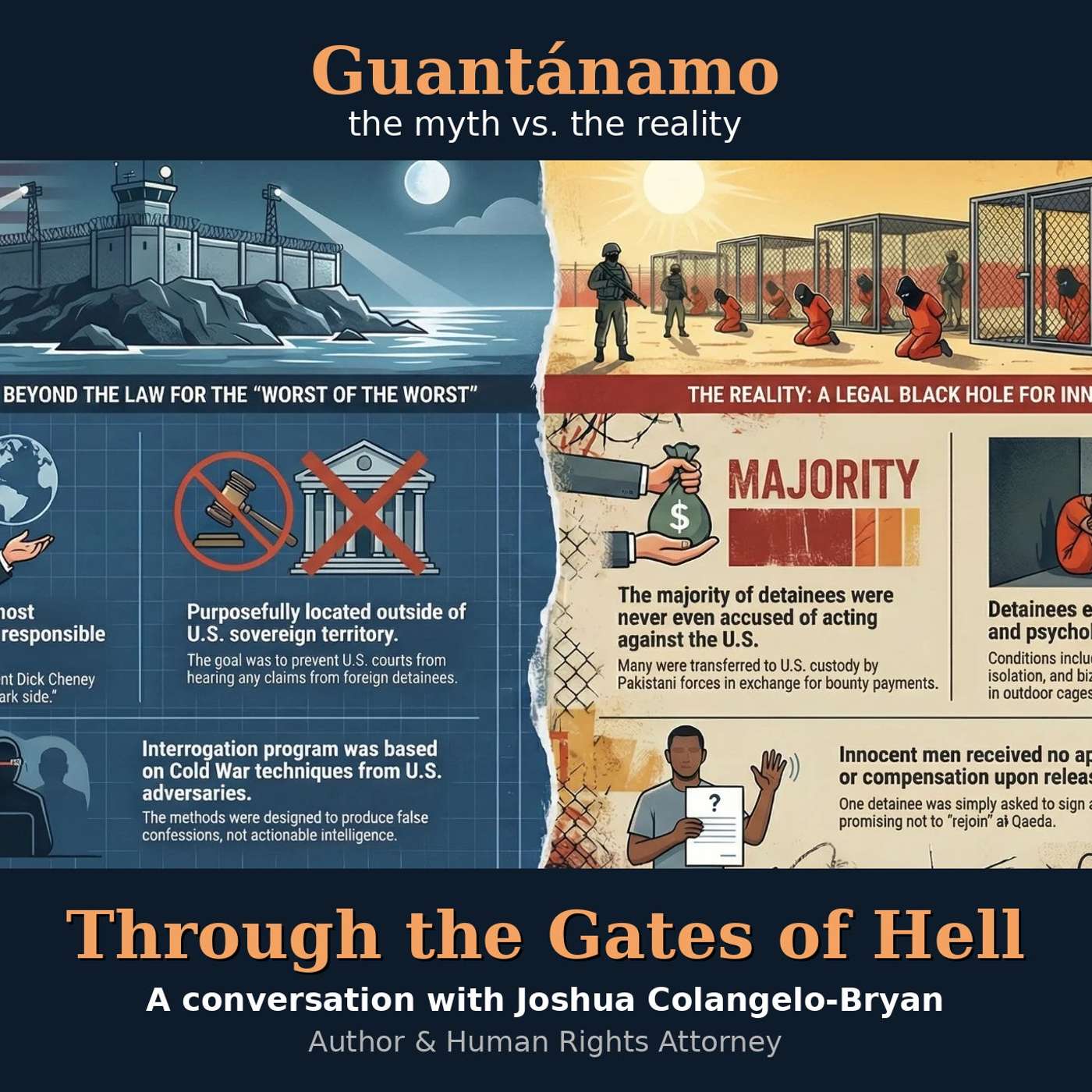

Guantanamo: The Myth vs the Reality
Dick Cheney died four weeks ago, but his dark legacy lives on—quite literally—at Guantanamo Bay. The human rights lawyer Joshua Colangelo-Bryan was among the first attorneys to enter the notorious prison in 2004, and what he found there shattered every official justification for its existence. The “worst of the worst”? Most detainees were never even accused of acting against America. Many were simply sold to the Americans for bounties. The sophisticated interrogation program? Techniques copied from Chinese and Soviet methods designed to extract false confessions, not intelligence. In his new book Through the Gates of Hell, Colangelo-Bryan tells the story of his unlikely friendship with Jaber Mohammed, a Bahraini detainee who spent years in captivity for the crime of being an Arab man in the wrong place (Afghanistan) at the wrong time (post 9/11). Released without apology or compensation—just a form asking him not to “rejoin” organizations he’d never belonged to—Jaber now lives in Saudi Arabia with four children, focusing less on bitterness and more on those rare moments when American guards showed him unexpected kindness. As the Trump administration revives the “worst of the worst” rhetoric against immigrants and once again sends people to Guantanamo, Colangelo-Bryan’s account is a warning from recent history: demonize a racial or religious group, and you will inevitably destroy innocent lives. The gates of hell have once again been opened. Will they ever be closed?
This is a public episode. If you'd like to discuss this with other subscribers or get access to bonus episodes, visit keenon.substack.com/subscribe
The Chile Project: Sebastian Edwards on the story of the Chicago Boys and the downfall of neoliberalism
The Siberian Job: John Kleinheinz on how he got rich in post-communist Russia and what that experience taught him about the value of free markets and democracy
Crime and Punishment for the Jews: Paul Goldberg on "The Dissident", his new Cold War mystery about a group of refuseniks in Moscow in 1976
Having Pride in Pride: Abdi Nazemian on why he's happy being thought of as a queer writer
Here Begins the Global Age: Meredith Small explains how a 15th century Venetian monk drew a map of the world and foresaw the future
The Best of New York City Distilled into a Neighborhood Bar: Jon Michaud on the life and death of Coogan's, one of New York's most beloved saloons
Against the Fetishization of Identity: Umut Ozkirimli offers a leftist alternative to what he sees as the intolerance of "woke" politics
Body Neutrality: Jessi Kneeland on the psychology and spirituality of escaping body self-hatred
The Search for Justice in America: Jared Fishman on the cold-blooded murder of Henry Glover by the New Orleans Police Department after Hurricane Katrina
The Survivor's Story of a Gay Activist: Paul Burston on how we can all be heroes, just for one day
Secrets from a Victorian Woman's Wardrobe: Kate Strasdin on fashion, fabric and femininity in 19th century England
The Most American of Americans: How African-American slaves embraced the new Republic's symbols of freedom in their fight for freedom
The Twisted Games We Play: Siena Sterling on twisted plots, twisted people and twisted writers like Highsmith and Dostoievski