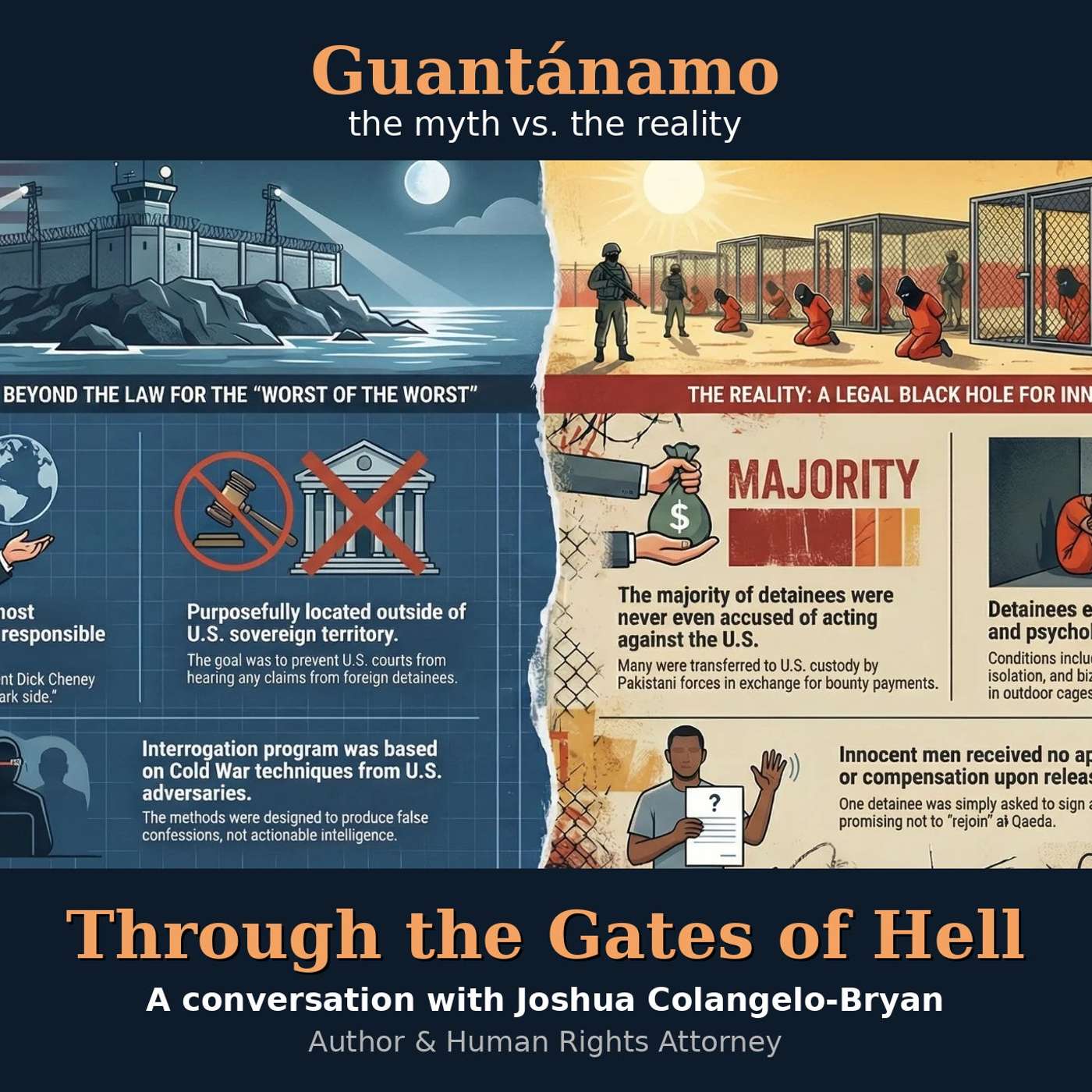

Guantanamo: The Myth vs the Reality
Dick Cheney died four weeks ago, but his dark legacy lives on—quite literally—at Guantanamo Bay. The human rights lawyer Joshua Colangelo-Bryan was among the first attorneys to enter the notorious prison in 2004, and what he found there shattered every official justification for its existence. The “worst of the worst”? Most detainees were never even accused of acting against America. Many were simply sold to the Americans for bounties. The sophisticated interrogation program? Techniques copied from Chinese and Soviet methods designed to extract false confessions, not intelligence. In his new book Through the Gates of Hell, Colangelo-Bryan tells the story of his unlikely friendship with Jaber Mohammed, a Bahraini detainee who spent years in captivity for the crime of being an Arab man in the wrong place (Afghanistan) at the wrong time (post 9/11). Released without apology or compensation—just a form asking him not to “rejoin” organizations he’d never belonged to—Jaber now lives in Saudi Arabia with four children, focusing less on bitterness and more on those rare moments when American guards showed him unexpected kindness. As the Trump administration revives the “worst of the worst” rhetoric against immigrants and once again sends people to Guantanamo, Colangelo-Bryan’s account is a warning from recent history: demonize a racial or religious group, and you will inevitably destroy innocent lives. The gates of hell have once again been opened. Will they ever be closed?
This is a public episode. If you'd like to discuss this with other subscribers or get access to bonus episodes, visit keenon.substack.com/subscribe
The Heartbeat of the Wild: David Quammen's conservationist manifesto from landscapes of wonder, peril and hope
Do You Dream of Electric Sheep? Jordan Crandall on the appropriate literature for our new age of superintelligence
That Was The Week in Tech: Keith Teare predicts a failed Apple virtual reality headset but is more bullish on Twitter's reinvention as X
Message on an Envelope: Stephen Games rethinks the publishing industry by reimagining books as postcards
The 7 Deadly Myths: Alex Ryvchin on antisemitism from the time of Christ to Kanye West and the Ashburton Army
The Wounded World: Chad Williams on W.E.B. Du Bois and the First World World
Anything but Halycon: Elliot Ackerman imagines an America of President Al Gore in which there is technology that can resurrect dead people
Our Kids Will Ask Us What We Did: Skye Perryman explains why she is fighting to save American democracy
Like the Appearance of Horses: Andrew Krivak on war, language, memory and why ChatGPT will never understand beauty
The World as a Big Book Club: David Blake explains the resiliency of the physical book and why he is cautiously optimistic about the impact of AI on both publishing and storytelling
Carry Strong: Stephanie Kramer offers an empowered approach to navigating pregnancy and work
Talking Turkey: Soli Özel makes sense of President Recep Tayyip Erdogan's return to political power
How to Scale Trust: David Samson on making tribes and tribalism work in the 21st century