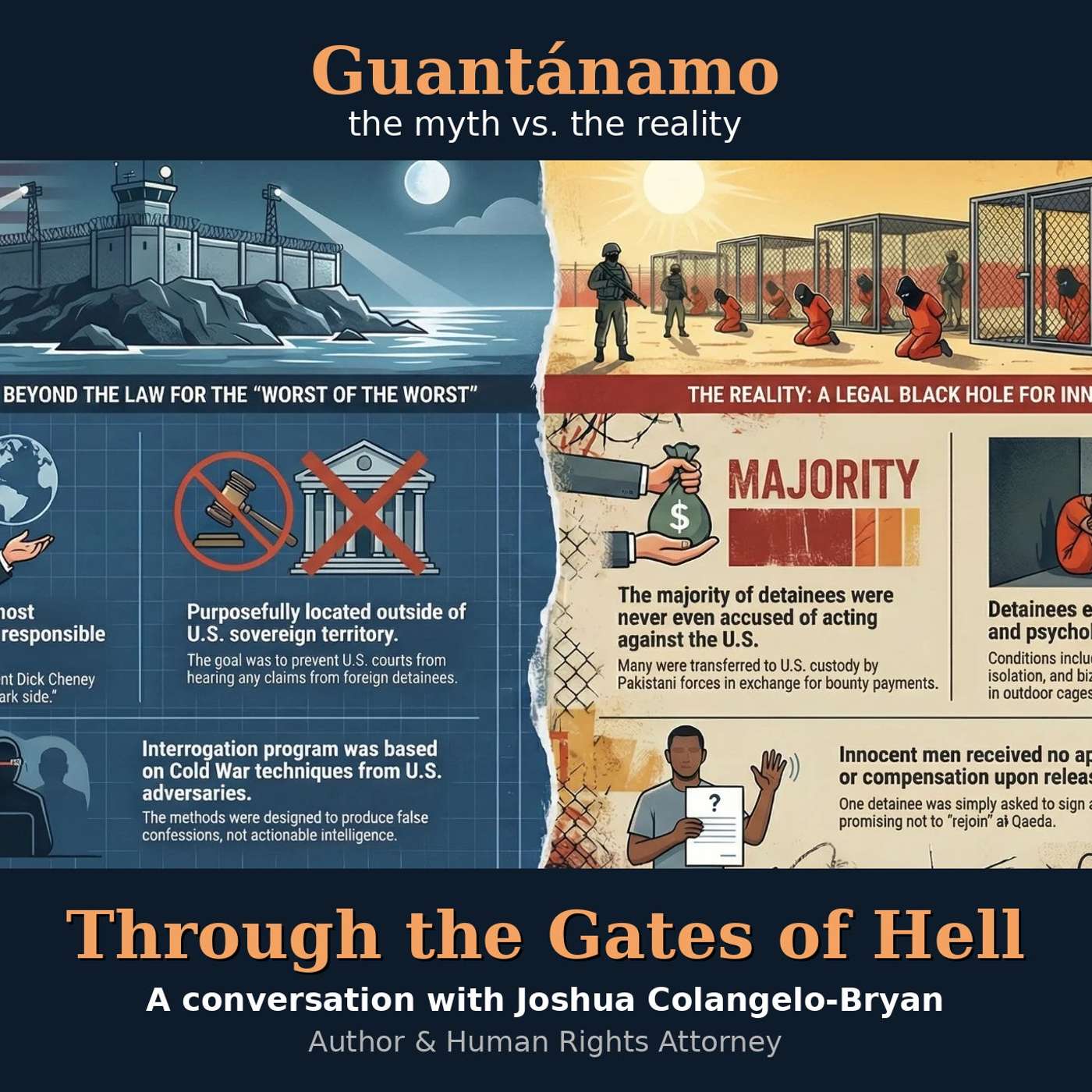

Guantanamo: The Myth vs the Reality
Dick Cheney died four weeks ago, but his dark legacy lives on—quite literally—at Guantanamo Bay. The human rights lawyer Joshua Colangelo-Bryan was among the first attorneys to enter the notorious prison in 2004, and what he found there shattered every official justification for its existence. The “worst of the worst”? Most detainees were never even accused of acting against America. Many were simply sold to the Americans for bounties. The sophisticated interrogation program? Techniques copied from Chinese and Soviet methods designed to extract false confessions, not intelligence. In his new book Through the Gates of Hell, Colangelo-Bryan tells the story of his unlikely friendship with Jaber Mohammed, a Bahraini detainee who spent years in captivity for the crime of being an Arab man in the wrong place (Afghanistan) at the wrong time (post 9/11). Released without apology or compensation—just a form asking him not to “rejoin” organizations he’d never belonged to—Jaber now lives in Saudi Arabia with four children, focusing less on bitterness and more on those rare moments when American guards showed him unexpected kindness. As the Trump administration revives the “worst of the worst” rhetoric against immigrants and once again sends people to Guantanamo, Colangelo-Bryan’s account is a warning from recent history: demonize a racial or religious group, and you will inevitably destroy innocent lives. The gates of hell have once again been opened. Will they ever be closed?
This is a public episode. If you'd like to discuss this with other subscribers or get access to bonus episodes, visit keenon.substack.com/subscribe
The Phoenix Economy: Felix Salmon on work, life and the price of lobster rolls in the new not normal
The Cult of Celebrity: Landon Jones on how America has devolved into a culture of fans and followers
Why Night Vision is the Right Vision: Mariana Alessandri on how the natural human condition might might be to live in darkness, anger and pain
Decision Sprint: Atif Rafiq on whether innovation is an art or a science
A Scientific Theory of Complexity: Neil Theise on Connection, Consciousness and Being
:Why Smart Machines Know Us So Well: John Borthwick on how today's AI revolution is being built upon social media data
Can the GOP Win the Independent Vote? Carl Delfeld on how Republicans existential challenge of reaching non-aligned voters
We Plan, God Laughs: Emma Nadler on how good and bad luck, like laughter and tears, are often inseparably connected
That Was The Week in Tech: Keith Teare explains why all this week's King Canute style talk about regulating AI is equally absurd and impractical
Why Asian Start-ups Outside China Matter: Bernard Moon on innovation in South Korea, Taiwan and Vietnam
The Traffic Drug: Ben Smith on the Internet's fatal addiction to viral traffic
Andrew Tate, Mr Beast, KSI and a Viral Flood of Toxic Masculinity: Henry Mance on what it means to be a boy online in 2023
Remembering the Beginnings of our Social Media Age: Julia Angwin on her earliest memories of the blogging "revolution"