Hi friends!
We're taking a much-needed summer pause—we'll have new episodes for you later in September. In the meanwhile, enjoy this pick from our archives!
-------
[originally aired June 1, 2023]
There's a common story about the human past that goes something like this. For a few hundred thousand years during the Stone Age we were kind of limping along as a species, in a bit of a cognitive rut, let's say. But then, quite suddenly, around 30 or 40 thousand years ago in Europe, we really started to come into our own. All of a sudden we became masters of art and ornament, of symbolism and abstract thinking. This story of a kind of "cognitive revolution" in the Upper Paleolithic has been a mainstay of popular discourse for decades. I'm guessing you're familiar with it. It's been discussed in influential books by Jared Diamond and Yuval Harari; you can read about it on Wikipedia. What you may not know is that this story, compelling as it may be, is almost certainly wrong.
My first guest today is Dr. Eleanor Scerri, an archaeologist at the Max Planck Institute for the Science of Human History, where she heads the Pan-African Evolution research group. My second guest is Dr. Manuel Will, an archaeologist and Lecturer at the University of Tübingen in Germany. Together, Eleanor and Manuel are authors of a new paper titled 'The revolution that still isn't: The origins of behavioral complexity in Homo sapiens.' In the paper, they pull together a wealth of evidence showing that there really was no cognitive revolution—no one watershed moment in time and space. Rather, the origins of modern human cognition and culture are to be found not in one part of Europe but across Africa. And they're also to be found much earlier than that classic picture suggests.
Here, we talk about the "cognitive revolution" model and why it has endured. We discuss a seminal paper from the year 2000 that first influentially challenged the revolution model. We talk about the latest evidence of complex cognition from the Middle Stone Age in Africa—including the perforation of marine shells to make necklaces; and the use of ochre for engraving, painting, and even sunblock. We discuss how, though the same complex cognitive abilities were likely in place for the last few hundred thousand years, those abilities were often expressed patchily in different parts of the world at different times. And we consider the factors that led to this patchy expression, especially changes in population size.
I confess I was always a bit taken with this whole "cognitive revolution" idea. It had a certain mystery and allure. This new picture that's taking its place is certainly a bit messier, but no less fascinating. And, more importantly, it's truer to the complexities of the human saga.
Alright friends, on to my conversation with Eleanor Scerri & Manuel Will. Enjoy!
A transcript of this episode is available here.
Notes and links
3:30 – The paper by Dr. Scerri and Dr. Will we discuss in this episode is here. Their paper updates and pays tribute to a classic paper by McBrearty and Brooks, published in 2000.
6:00 – The classic "cognitive revolution" model sometimes discussed under the banner of "behavioral modernity" or the "Great Leap Forward." It has been recently featured, for instance, in Harari's Sapiens.
11:00 – Dr. Scerri has written extensively on debates about where humans evolved within Africa—see, e.g., this paper.
18:00 – A study of perforated marine shells in North Africa during the Middle Stone Age. A paper by Dr. Will and colleagues about the use of various marine resources during this period.
23:00 – A paper describing the uses of ochre across Africa during the Middle Stone Age. Another paper describing evidence for ochre processing 100,000 years ago at Blombos Cave in South Africa. At the same site, engraved pieces of ochre have been found.
27:00 – A study examining the evidence that ochre was used as an adhesive.
30:00 – For a recent review of the concept of "cumulative culture," see here. We discussed the concept of "cumulative culture" in our earlier episode with Dr. Cristine Legare.
37:00 – For an overview of the career of the human brain and the timing of various changes, see our earlier episode with Dr. Jeremy DeSilva.
38:00 – An influential study on the role of demography in the emergence of complex human behavior.
41:00 – On the idea that distinctive human intelligence is due in large part to culture and our abilities to acquire cultural knowledge, see Henrich's The Secret of Our Success. See also our earlier episode with Dr. Michael Muthukrishna.
45:00 – For discussion of the Neanderthals and why they may have died out, see our earlier episode with Dr. Rebecca Wragg Sykes.
Recommendations
Dr. Scerri recommends research on the oldest Homo sapiens fossils, found in Morocco and described here, and new research on the evidence for the widespread burning of landscapes in Malawi, described here.
Dr. Will recommends the forthcoming update of Peter Mitchell's book, The Archaeology of Southern Africa.
See Twitter for more updates from Dr. Scerri and Dr. Will.
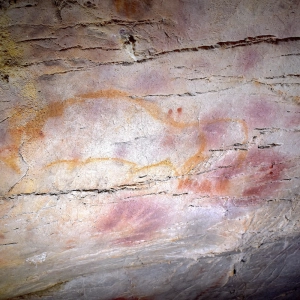
Tile image credit: Image adapted from Chenshilwood via Wikipedia (CC by 2.5)
Many Minds is a project of the Diverse Intelligences Summer Institute, which is made possible by a generous grant from the John Templeton Foundation to Indiana University. The show is hosted and produced by Kensy Cooperrider, with help from Assistant Producer Urte Laukaityte and with creative support from DISI Directors Erica Cartmill and Jacob Foster. Our artwork is by Ben Oldroyd. Our transcripts are created by Sarah Dopierala.
Subscribe to Many Minds on Apple, Stitcher, Spotify, Pocket Casts, Google Play, or wherever you listen to podcasts. You can also now subscribe to the Many Minds newsletter here!
We welcome your comments, questions, and suggestions. Feel free to email us at: manymindspodcast@gmail.com.
For updates about the show, visit our website or follow us on Twitter (@ManyMindsPod) or Bluesky (@manymindspod.bsky.social).