It seems we've always had monsters among us. We've long been enthralled by dragons and giants, by the likes of Frankenstein and Godzilla and Dracula, by witches and werewolves and countless others. They roam our maps and creation myths; they crop up in our dreams, in our children's books, in our political rhetoric. Where do these beings spring from? What do they do for us? How have they changed over time? And, ultimately, what do our monsters say about their makers?
My guests today are Dr. Natalie Lawrence and Dr. Surekha Davies. Both are historians of science and authors of recent books on monsters: Natalie's book is Enchanted creatures: Our monsters and their meanings. Surekha's book is Humans: A monstrous history.
Here, Surekha, Natalie, and I talk about monsters as category breakers and boundary walkers—and about how monstrosity is in the eye of the beholder. We walk through a menagerie of monsters—from the apocryphal blemmyes of old travelogues, to a hairy-faced girl in 16th century France, to the figure of Caliban in The Tempest. We discuss the psychological and cultural forces that generate monsters. And we talk about whether anyone would want to live in a world without them.
Along the way, we touch on the "monstrification" of social groups; psychoanalysis; our primal fear of snakes; curiosity cabinets; therianthropes and the Cave of the Three Brothers; the relationship between monstrosity and geography; our long fascination with so-called monstrous births; the Muppet Show; dinosaurs and sea creatures; and the question of what monsters might do for children in particular.
Alright friends, it's the monstrous season and this is a fun one to help you celebrate. Enjoy!
Notes
3:00 – Grendel's mother has often been a subject of critical discussion and adaptation. See, for instance, the 2018 novel, The Mere Wife.
12:30 – For a classic history-of-science treatment of "wonders" (including monsters) and our conceptions of nature, see here.
18:30 – For those unfamiliar with muppets, an episode of the Muppet Show, which premiered in 1976.
24:00 – The blemmyes were often the subjects of illustration—for examples, see here.
26:00 – For more on Sir Walter Raleigh and the blemmyes, see Dr. Davies' recent newsletter post.
29:00 – One example of monsters at the margins of maps can be seen in the Psalter World Map.
32:00 – For more on Cave of the Trois-Frères and the Sorcerer, see here.
34:00 – For more on shamanism, see our recent episode with Manvir Singh.
37:00 – Therianthropes are relatively rare in cave art, but have nonetheless been widely discussed. For an example, see here.
39:00 – For more on Antonietta Gonsalvus and her family, including examples of how she was represented in paintings of the era, see here.
45:00 – The trope of monsters in creation stories is often called "chaoskampf."
47:00 – The meanings of Medusa have been widely discussed and debated. See here for an example.
52:00 – For more about Caliban, and the racial and colonial dimensions of the Tempest, see here.
57:00 – The Steinbeck quote comes from his book, The Log from 'The Sea of Cortez.'
Recommendations
The Ashgate Research Companion to Monsters and the Monstrous, edited by Asa Simon Mittman & Peter J. Dendle
Spectacle of Deformity, by Nadja Durbach
The Modern Myths, by Philip Ball
The Monsters and the Critics (and other essays), by J.R.R. Tolkien
No Go the Bogeyman, by Marina Warner
Where the Wild Things Are, by Maurice Sendak
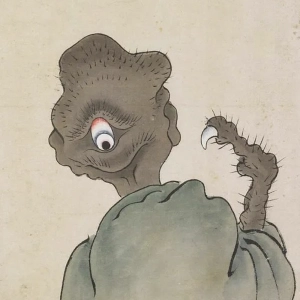
Tile image credit: Image from the Bakemono Zukushi "Monster" Scroll via Public Domain Review
Many Minds is a project of the Diverse Intelligences Summer Institute, which is made possible by a generous grant from the John Templeton Foundation to Indiana University. The show is hosted and produced by Kensy Cooperrider, with help from Assistant Producer Urte Laukaityte and with creative support from DISI Directors Erica Cartmill and Jacob Foster. Our artwork is by Ben Oldroyd.
Subscribe to Many Minds on Apple, Stitcher, Spotify, Pocket Casts, Google Play, or wherever you listen to podcasts. You can also now subscribe to the Many Minds newsletter here!
We welcome your comments, questions, and suggestions. Feel free to email us at: manymindspodcast@gmail.com.
For updates about the show, visit our website or follow us on Bluesky (@manymindspod.bsky.social).