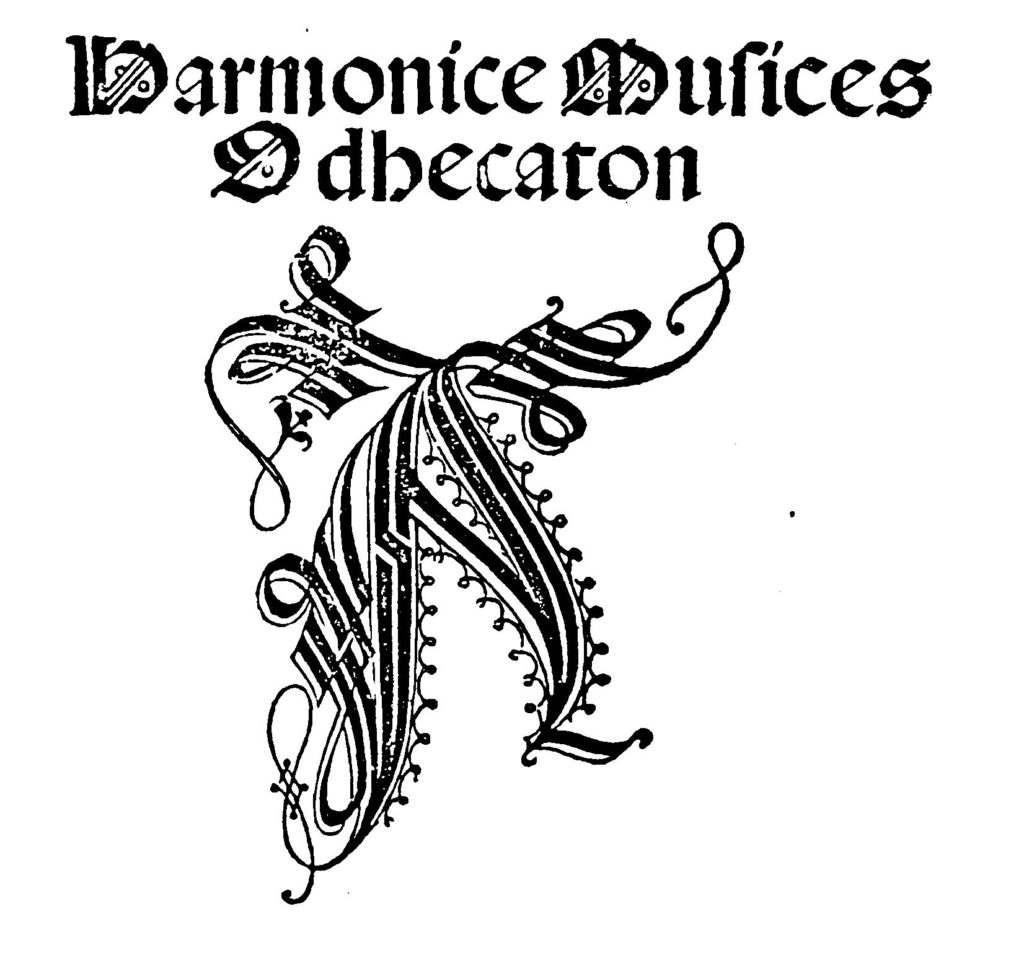
Frontispiece to the Harmonice musices odhecaton A, published on May 15, 1501
On May 15, 1501 – 522 years ago today – the first polyphonic (that is, multi-part) music printed using moveable type was released to the public by the Venice-based publisher Ottaviano dei Petrucci. (The publication features a dedication dated May 15, 1501, so we assume that this corresponds with its release date.) The publication was an anthology of works entitled Harmonicemusices odhecaton A, meaning “One Hundred Pieces of Harmonic Music, Volume A”. (Volumes “B” and “C” followed in 1502 and 1503, respectively). In fact, “One Hundred Pieces of Harmonic Music, Volume A” consists of 96 (not “100”, as the title claims) instrumental works and French-language songs by some of the most famous composers of the day, as well as some anonymous works as well. Those famous composers represented in the anthology – which include Josquin de Prez, Johannes Ockeghem, Jacob Obrecht, Antoine Brumel, and Alexander Agricole – were all originally from northern France and southern Belgium: the so-called “Franco-Flemish” composers from the “oltre montani” (“the other side of the Alps”) who were so popular in Italy at the time.
I am aware that that previous, opening paragraph, filled with relatively obscure Italian and Franco-Flemish names, musicological rubric, and featuring an obscure, Latin-titled anthology – Harmonice musices odhecaton A -might have crossed your eyes and loosened your bladders even as it threatened to put you to sleep.
But!
But, but!
But in fact, the publication of “One Hundred Pieces of Harmonic Music, Volume A” in 1501 was a huge, big deal in the history of Western music, an event we can accurately call a “game changer”!
In reference to human evolution and development, there have been all sorts of large-case game changers: the control of fire; the invention of clothing; the development of tools and the invention of the wheel; the rise of agriculture; the ability to smelt, forge, and alloy metals; the harnessing of steam, and so forth. But I would argue that collectively, the most important game-changers in the evolution and development of humanity have to do with information transfer, starting with the development of language.
While it now appears likely that our ancestor homo erectus “invented” some sort of “grunted” language as long as 2 million years ago, complex language only emerged among the most loquacious of human species – that being we homo sapiens – some 150,000 years ago, as a systematic way for modern humans to communicate.
Next to language, sliced bread as a game changer is, well, overrated. …
Every week, Music History Monday arrives with the kind of curiosity that turns dates on a calendar into doorways. Hosted by composer and historian Robert Greenberg, this podcast digs into the stories that happened *around* the music, finding the human moments-sometimes profound, sometimes scandalous, always fascinating-tied to a specific Monday. Greenberg approaches his subjects not as distant icons but as the complicated, brilliant, and often messy people they were, which makes each episode feel like a conversation rather than a lecture. You’ll hear about pivotal premieres, bitter rivalries, unexpected inspirations, and the sheer luck or misfortune that shaped the pieces we know today. The tone is erudite but never dry, packed with context and delivered with a wit that respects the art without putting it on a sterile pedestal. It’s for anyone who loves a good story and suspects that the history behind a symphony or a sonata is just as compelling as the notes themselves. Tune in each Monday with Robert Greenberg to connect the dots between a day in history and the soundtrack it inspired.
Author: Robert Greenberg
Language: en-us
Episodes: 100