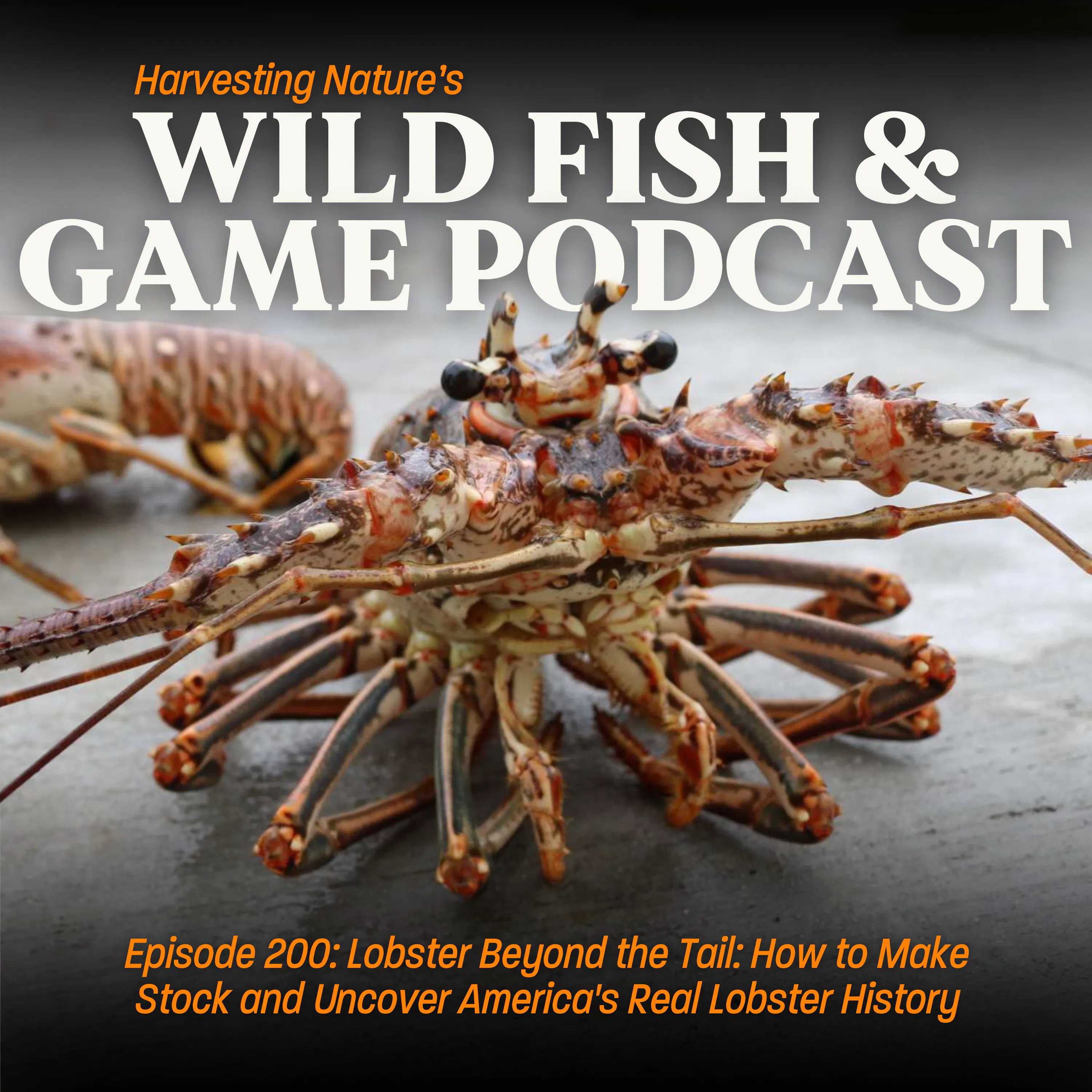
Episode 200: Lobster Beyond the Tail: How to Make Stock and Uncover America's Real Lobster History
Author: Harvesting Nature
August 28, 2024
Duration: 14:48
“I am a huge proponent of using as much of the animal as possible. Many folks disregard the head, legs, and other parts of the lobster when cleaning. In Florida, I have seen more people rip the tail off of the lobster and toss the head back in the water. Not only do they miss some of the meat inside the head, but they also toss out an excellent resource for making stock.
My lobster cleaning method is slightly different and involves splitting the lobster down the middle of the head and then cutting away the tail meat. I discard the stomach sack because it imparts some untasteful flavors in the stock. I clean out the anus of the lobster and then split the tail in half as well. The head is full of great flavor, captured in the stock recipe below. You can use the lobster stock for preparing rice, making soups, and so much more.” -Justin Townsend
Read the written version of this recipe as prepared by Justin Townsend
Leave a Review of the Podcast
Listen to our other podcasts here
Buy our Small Batch Wild Food Spice Blends
About Eating Lobsters
As a food item, lobsters have had a fascinating history in North America. Pretty much anyone with a passing interest in food history or a penchant for imparting random factoids will be happy to tell you that lobsters were once so detested that they were only fed to prisoners. The prisoners eventually became so fed up with eating the crustaceans that they rioted and demanded laws be put in place to limit the amount of lobster served to them.
Now, that’s a cool, juicy factoid, and one that I have passed on to disinterested listeners who were forced to be in the same room as me. Is it actually a fact, though?
Thousands of online articles and threads would have you believe that it is a factual part of American history, some even going so far as saying that the lobster was ground up, shell and all, before being served.
In my research for this episode, though, I dug deep enough to find a few scholars who said there isn’t any evidence pointing to the veracity of this claim.
According to food historian Kathleen Curtin, prisoners enacting laws to limit how often they were fed lobster is a myth, and there isn’t a shred of documentation of it happening.
Hmm. Like many food myths, this one was started by someone a long time ago and latched on and repeated by countless buzzy online writers and garrulous know-it-alls.
Since that was supposed to be the premise of this episode, I’m left scrambling for something else to talk about. Luckily, the history of lobster is still just as rich as its sweet, butter-drenched meat.
Let’s put a plastic bib on, crack it open, and take a look.
About Adam Berkelmans:
Adam Berkelmans, also known as The Intrepid Eater, is a passionate ambassador for real food and a proponent of nose-to-tail eating. He spends his time between Hull, Quebec, and a cozy lake house north of Kingston, Ontario. When not cooking, he can be found hunting, fishing, foraging, gardening, reading, traveling, and discovering new ways to find and eat food.
Follow Adam on Instagram
Visit the Intrepid Eater website
Learn more about your ad choices. Visit megaphone.fm/adchoices